ggsrun was updated to v5.3.7.
- v5.3.7 (June 2026) - Simplified Quick Onboarding, On-demand Setup Prompting, Optional Credentials Path, and Seamless Configuration Initializer
Introduced the groundbreaking, extremely easy-to-use
$ ggsrun setup onboarding command to dramatically simplify Google Cloud API and OAuth2 credentials setup, while keeping traditional $ ggsrun auth fully intact for backward compatibility. This command automates Google Cloud Workspace API enablement (Drive, Sheets, Slides, Docs, Google Apps Script, Gmail) using GCP Quick Flows, immediately redirecting users straight to the Credentials creation page. It removes any credential filename renaming constraints (you can load credentials from any custom file path like {your path}/{credential name}.json rather than renaming to exactly client_secret.json) or supports manual credential copy-pasting. Added a dynamic config initializer (ggsrunIniForSetup) to gracefully bypass “missing client_secret.json” startup errors on first-time runs, and added interactive prompts to configure Script IDs and Web Apps URLs with automated pre-filled defaults from existing configurations.
You can check ggsrun at https://github.com/tanaikech/ggsrun.
ggsrun was updated to v5.3.3.
- v5.3.3 (June 2026) - Recursive Directory Walk, Safe Interactivity & GAS Zip Download
Enhanced
updateproject (alias ud) command to recursively traverse folders specified via -f / --filename to batch overwrite remote GAS projects. Prints targeted local files in a beautiful bullet list using pterm.BulletListPrinter and requires explicit interactive confirmation (Y/N) in CLI/TUI modes before mutating Google Drive files. Supported downloading whole Apps Script projects directly as local packaged .zip archives via ggsrun download -i <fileId> -z. Added robust security warnings to the updateproject MCP tool description directing AI agents to obtain user approval before calling the tool. Introduced a complete automated integration testing suite (cli_test.go) validating download structures, document conversions, standalone uploads, and binary fallbacks.
- v5.3.2 (June 2026) - Script Upload Flag Registration and TUI Focus Fallbacks
Fixed a TUI upload crash where converting and uploading
.js/.gs files to standalone Apps Script projects threw a panic: internal process exited with code 1 due to unregistered projectname and googledocname flags in createOpContext. Integrated full text file previews on Enter for remote files, and implemented dynamic importFormats MIME type lookup via utl.GetImportTargets to automatically bypass conversion prompts for unconvertible file types, as well as robust focus restoration.
- v5.3.1 (June 2026) - Script Upload Routing Fixes, Non-Convertible Upload Fallbacks, and TUI Error Propagation
Fixed a bug in
concurrentUpload that caused .js/.gs/.gas uploads to throw HTTP 400 Bad Request by redirecting script project uploads to the Apps Script project builder and overriding raw script uploads to text/plain. Allowed non-Workspace files (such as .zip or .mp3) to bypass conversion checks and upload as-is when no conversion format is requested. Integrated TransferResult and FileInf error inspections in the TUI filer (ggsrun fd) to propagate upload/download failures to the user instead of failing silently.
You can check ggsrun at https://github.com/tanaikech/ggsrun.
ggsrun was updated to v5.3.0.
- v5.3.0 (June 2026) - Responsive TUI Filer (FD Mode) Enhancements, Focus Persistence, and Platform Compatibility Fixes
Refactored TUI Filer (FD Mode) popup layouts using
tview.Flex to center dialogs (errors, sorting, details, help) and prevent text clipping. Implemented focus locking to preserve active panel focus post-action. Added wrap-around to lists and mapped the y key to yank (copy) selected file paths or File IDs to the clipboard. Resolved compilation errors on 32-bit Linux platforms (e.g. linux/arm) by explicitly casting syscall.Stat_t Ctim fields to int64 inside build-tagged files, and adapted the mock simulation test suite (fd_test.go) to match the new responsive structures.
- v5.2.4 (June 2026) - Latest MIME Type Formats, CLI Option Help Details, Concurrent Conversion Overhaul, and Destination Directory Support
Updated internal MIME type mapping definitions (
googlemimetypes.go) to synchronize with the latest Google Drive API importFormats/exportFormats. Revamped the CLI options help display for --extension (download/revision) and --convertto (upload) to explicitly list all supported formats. Overhauled the concurrent upload/download engines to handle --convertto / --noconvert directly in parallel streams without falling back to the legacy single-threaded uploader, adding validation capability checks and graceful error warning feedback. Added --destination (-d) option to the download and revision commands to allow specifying the target local directory for saving downloaded files.
- v5.2.3 (June 2026) - Directory Reuse Conflict Resolution, Output Control, and CLI/MCP Alignment
Upgraded the directory upload conflict resolution mechanism to silently and recursively reuse existing remote folders without prompting. Aligned the
--conflict-mode behavior for -j / --jsonparser CLI runs to match the automated MCP mode (defaulting to OverwriteIfNewer, overridable via --cm). Muted TUI output and progress bars (mpb) when running with the -j option to return clean JSON. Supported --cm as a shorthand alias for --conflict-mode in file transfers.
- v5.2.2 (June 2026) - MCP Help Display Expansion, Safety Review Prompt, Dual-Mode Conflict Engine, and File-Level Error Feedback
Expanded
ggsrun mcp -h (and --help) to display all exposed MCP tool names and their detailed description outputs directly. Implemented strict programmatic safety review prompts inside the exe1 MCP tool description, instructing LLMs to statically analyze Apps Script payloads for API mutations (write/update/delete) and obtain user Y/N confirmations before running, while allowing read-only scripts to run automatically. Re-designed the conflict resolution engine into a dual-mode system: automated and non-interactive for MCP server sessions (defaulting to OverwriteIfNewer, with options for Ignore and Rename), and preserving legacy interactive CLI prompts for raw executions. Refactored parallel transfer loops to capture and return detailed file-level error feedback instead of crashing.
- v5.2.1 (June 2026) - Dynamic CLI Help Customization, Beacon Script Integration, and Namespace Binding
Updated the CLI help systems for
e1, e2, and w to integrate comprehensive execution command examples (including stateless beacon checks) dynamically within both the --help flag screens and optionless execution error overlays. Fixed a namespace bug where evaluated scripts executing ggsrunif.Beacon() inside the library threw a ggsrunif is not defined ReferenceError, by binding ggsrunif to the library’s global execution context.
- v5.2.0 (June 2026) - Go standard layout, WSL2 browser integration, Web Apps URL registration, CLI UX hardening, and MCP Server Schema Improvements
Reorganized the codebase to follow the standard Go project structure (
main.go, /internal/app/, /internal/utl/). Expanded ggsrun auth to request Web Apps URL registration and dynamically persist it in ggsrun.cfg, allowing ggsrun w to run without the -u option. Integrated WSL 2 environment detection to prompt the user to choose between the Windows host browser, WSL/Ubuntu native browser, or manual URL copy-pasting. Upgraded ggsrun e1, ggsrun e2, and ggsrun w commands to dynamically print full CLI flag helps alongside custom usage examples. Improved the MCP server (ggsrun mcp) tools schema, adding rich parameter descriptions, Drive API query examples, new scriptfile/stringscript parameters to the exe1 schema, searchbyid parameter to the filelist schema, and making scriptid optional by resolving automatically from ggsrun.cfg (via GGSRUN_CFG_PATH or the local directory). Refined tools/call backend handling to safely strip null/empty values.
- v5.1.1 (May 2026) - Modular Handlers & Enhanced MCP Server Core
Refactored the codebase to modularize legacy single-file command handlers into dedicated, organized handler files (
handler_download.go, handler_upload.go, handler_transfer.go, handler_mcp.go, handler_execute.go). Strengthened the MCP server core (ggsrun mcp) by capturing stdout and stderr execution logs for comprehensive error recovery. Embedded full support for --conflict-mode inside the MCP JSON-RPC schemas and standardized file transfer outputs into TransferResult to support interactive multi-turn collision resolution in LLM conversations. Fully updated pre-built binaries for all major architectures.
- v5.1.0 (May 2026) - Advanced Conflict Resolution Engine
Introduced a robust pre-computation conflict resolution matrix for both
download and upload commands via the new --conflict-mode (-cm) flag. Users can now choose from skip, overwrite, rename (appends timestamp _YYYYMMDD_HHMMSS to avoid collisions), or update (syncs only if the source file is newer than the target). Includes interactive fallback CLI prompts if no mode is specified. Deprecated the legacy --overwrite (-o) and --skip (-s) options in favor of --conflict-mode. To avoid Drive API rate limits during massive concurrent uploads, metadata query is pre-fetched in bulk.
- v5.0.3 (May 2026) - CLI UX Overhaul & Dynamic TUI Integration
Introduced a highly visual, modern Terminal UI (TUI) powered by
pterm for exe1, exe2, and webapps commands. Added interactive loading spinners with anti-ghosting fixed-width padding (%-70s) and beautifully structured execution reports. Maintained strict backward compatibility by preserving pure JSON output streams via the -j flag for CI/CD pipeline automation.
- v5.0.2 (May 2026) - Secure Web Apps Protocol Upgrade
Upgraded the
webapps command to natively support “Only myself” execution deployments by bridging OAuth tokens (drive scope) across Google’s HTTP 302 Auth Redirects. Ported the IIFE/JSON-literal double-eval protections from exe2 to webapps.
- v5.0.1 (May 2026) - Execution Engine Hardening & Double-Eval Eradication
Eliminated the V8 engine double-eval 500 server crash during dynamic script execution by enforcing IIFE and JSON-literal payload encoding. Redefined
-f flag mapping for proper API gateway resolution in exe2. Added precision deployment documentation for stateful and stateless execution modes.
You can check ggsrun at https://github.com/tanaikech/ggsrun.
- v5.0.0 (May 2026) - The Omnibus Architecture Rewrite
Engine fundamentally rewritten for Go 1.26.3+. Implemented channel-based concurrency (
errgroup), freeze-proof TUI (mpb/v8), SIMD JSON parsing (goccy/go-json), native MCP server (ggsrun mcp), Shared Drives full-support, auto MIME-mapping, isolated fault tolerance, and OAuth2 loopback automation.
You can check ggsrun at https://github.com/tanaikech/ggsrun.
-
v3.2.2 (May 27, 2026)
- Critical Progress Bar Lifecycle Fix: Fixed a bug where indeterminate file sizes (such as Google Docs exports returning
0 size from the Drive API) caused the progress bar spinners to hang infinitely. Bar completion is now strictly enforced (SetTotal(-1, true)) upon IO completion.
- Resource Leak Patches: Hardened HTTP body and local file descriptor management using strictly placed
defer statements, preventing memory leaks during connection errors.
-
v3.2.1 (May 27, 2026)
-
v2.0.5 (March 10, 2023)
- From this version, when the API key is used, the large file is downloaded by the API key. Because the specification for downloading the shared large file is sometimes changed. When the API key is not used, the shared large file is downloaded by the current specification (v2.0.4). If the shared large file cannot be downloaded by the change of the specification on Google’s side, please use the API key and test it again. The usage of goodls has not changed.
The detail information and how to get this are https://github.com/tanaikech/goodls.
Gists
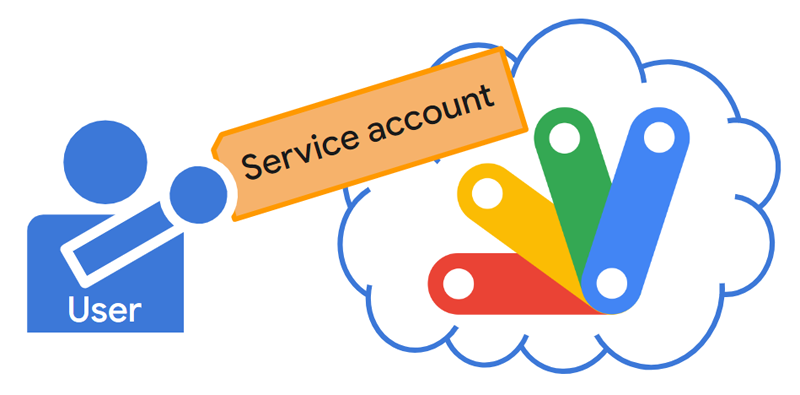
Abstract
One day, you might have a situation where it is required to run Google Apps Script using the service account. Unfortunately, in the current stage, Google Apps Script cannot be directly run with the service account because of the current specification. So, this report introduces a workaround for executing Google Apps Script using the service account.
Introduction
When you want to execute Google Apps Script from outside of Google, as the basic approach, it can be achieved by Google Apps Script API. Ref In order to use Google Apps Script, it is required to link the Google Apps Script project with the Google Cloud Platform project. Ref But, in the current stage, Google Apps Script can be executed by Google Apps Script API with only the access token obtained from OAuth2. Unfortunately, the access token obtained by the service account cannot used for executing Google Apps Script using Google Apps Script API. It seems that this is the current specification on the Google side. However, there might be a case that it is required to execute Google Apps Script using the service account. In this report, I would like to introduce a workaround for executing Google Apps Script using the service account. In this workaround, the Web Apps created by Google Apps Script is used. The Web Apps can be used for executing the preserved functions of doGet and doPost from outside of Google. Ref In this workaround, this Web Apps is used for executing the various functions.
go-gettokenbyserviceaccount was updated to v1.0.1
You can get this from https://github.com/tanaikech/go-gettokenbyserviceaccount
-
v2.0.3 (April 5, 2023)
- Forgot to update the version number and modified it. And, built the sources with the latest version. Ref
The detail information and how to get this are https://github.com/tanaikech/goodls.
goris is a CLI tool to search for images with Google Reverse Image Search.
Today, it was updated to v3.0.1. Please check it out. https://github.com/tanaikech/goris
-
v3.0.1 (May 2, 2022)
- About the option
-w, a bug was resolved. By this, the URLs of the related Web site are returned. As the default, 10 URLs are returned. If you want to retrieve more, please use the option -n like -n 20.
getcode was updated to v1.0.1
You can get this from https://github.com/tanaikech/getcode
The detail information and how to get this are https://github.com/tanaikech/goodls.
You can check ggsrun at https://github.com/tanaikech/ggsrun.
The detail information and how to get this are https://github.com/tanaikech/goodls.
go-getfilelist was updated to v2.0.0
You can get this from https://github.com/tanaikech/go-getfilelist
goris is a CLI tool to search for images with Google Reverse Image Search.
Today, it was updated to v3.0.0. Please check it out. https://github.com/tanaikech/goris
The detail information and how to get this are https://github.com/tanaikech/goodls.
Gists
This is a simple method for using ggsrun. ggsrun is a CLI tool to execute Google Apps Script (GAS) on a terminal. Also this CLI tool can be used for managing files in Google Drive for OAuth2 and Service Account.
When you use ggsrun, it is required to retrieve the client ID and client secret and/or the service account at Cloud Platform Project. But, there is the case that you want to simply test or you want to just upload and download the files for Google Drive. In this post, I would like to introduce how to simply use ggsrun.
gislack is a CLI tool to submit files to both Gist and Slack.
Please check it out. https://github.com/tanaikech/gislack
Gists
This is the sample scripts for creating new event with Google Meet link to Google Calendar using various languages. When I saw the official document of “Add video and phone conferences to events”, in the current stage, I can see only the sample script for Javascript. But I saw the several questions related to this for various languages. So I published the sample scripts for creating new event with Google Meet link to Google Calendar using various languages.
Updated: GetFileList for golang, Javascript, Node.js and Python
This is the libraries to retrieve the file list with the folder tree from the specific folder of own Google Drive and shared Drives.
go-getfilelist was updated to v1.0.3
-
v1.0.3 (May 14, 2020)
-
Shared drive got to be able to be used. The file list can be retrieved from both your Google Drive and the shared drive.
- For example, when the folder ID in the shared Drive is used
folderID of Folder(folderID), you can retrieve the file list from the folder in the shared Drive.
You can get this from https://github.com/tanaikech/go-getfilelist
goris is a CLI tool to search for images with Google Reverse Image Search.
Today, it was updated to v2.0.0. Please check it out. https://github.com/tanaikech/goris
-
v2.0.0 (April 23, 2020)
- The specification for running the reverse image search was changed at Google side. By this, this application was also changed.
-
v1.7.4 (March 11, 2020)
-
Recently, I noticed that new Google Apps Script project of the standalone script type cannot be created by the create method of Drive API. From now, in order to create the standalone Google Apps Script project, only Google Apps Script API is required to be used. Ref By this, I updated ggsrun. So the command for creating new GAS project is not changed.
$ ggsrun u -p ###folderId### -f sample.gs -pn sampleGASProjectName
You can check ggsrun at https://github.com/tanaikech/ggsrun.
The detail information and how to get this are https://github.com/tanaikech/goodls.
The detail information and how to get this are https://github.com/tanaikech/goodls.
Libraries of gdoctableapp for golang, Node.js and python were updated to v1.1.0
Libraries of gdoctableapp for golang, Node.js and python were updated to v1.0.5
Update History
I knew that the specification of github.com/urfave/cli had been changed by the update of https://github.com/urfave/cli. By this, when the CLI created by golang is installed with go get, an error occurred. So this error was removed.
The updated CLI tools are as follows.
The detail information and how to get this are https://github.com/tanaikech/goodls.
gonetatmo was updated to v.1.0.1
-
v1.0.1 (August 2, 2019)
- A bug was removed.
- When the outer module is not active, an error occurred. In this version, this bug was removed.
You can check gonetatmo at https://github.com/tanaikech/gonetatmo.
Gists
This is a sample script for the resumable upload of Files to Google Drive using Golang. This script uses the library of google-api-go-client. About the installation of google-api-go-client, please check the Quickstart for golang at the official site.
Sample script:
package main

import (
	"context"
	"encoding/json"
	"fmt"
	"io/ioutil"
	"log"
	"net/http"
	"os"

	drive "google.golang.org/api/drive/v3"

	"golang.org/x/oauth2"
	"golang.org/x/oauth2/google"
	"golang.org/x/oauth2/jwt"
)

// ServiceAccount : Use Service account
func ServiceAccount(credentialFile string) *http.Client {
	b, err := ioutil.ReadFile(credentialFile)
	if err != nil {
		log.Fatal(err)
	}
	var c = struct {
		Email      string `json:"client_email"`
		PrivateKey string `json:"private_key"`
	}{}
	json.Unmarshal(b, &c)
	config := &jwt.Config{
		Email:      c.Email,
		PrivateKey: []byte(c.PrivateKey),
		Scopes: []string{
			drive.DriveScope,
		},
		TokenURL: google.JWTTokenURL,
	}
	client := config.Client(oauth2.NoContext)
	return client
}

func main() {
	filename := "sample.txt"     // Filename
	baseMimeType := "text/plain" // MimeType
	client := ServiceAccount("credential.json") // Please set the json file of Service account.

	srv, err := drive.New(client)
	if err != nil {
		log.Fatalln(err)
	}
	file, err := os.Open(filename)
	if err != nil {
		log.Fatalln(err)
	}
	fileInf, err := file.Stat()
	if err != nil {
		log.Fatalln(err)
	}
	defer file.Close()
	f := &drive.File{Name: filename}
	res, err := srv.Files.
		Create(f).
		ResumableMedia(context.Background(), file, fileInf.Size(), baseMimeType).
		ProgressUpdater(func(now, size int64) { fmt.Printf("%d, %d\r", now, size) }).
		Do()
	if err != nil {
		log.Fatalln(err)
	}
	fmt.Printf("%s\n", res.Id)
}
Note:
- In this sample, the Service account is used. So the file is uploaded to the Service account’s Drive. When
client retrieved from OAuth2 is used, the file is uploaded to owner’s Drive.
References:
Gists
This is a sample script for creating a table to Google Document by retrieving values from Google Spreadsheet for Golang.
Before you use this script, please install go library of go-gdoctableapp.
$ go get -v -u github.com/tanaikech/go-gdoctableapp
Sample script:
This sample script uses Service Account.
In this sample script, the values are retrieved from Sheet1!A1:C5 of Spreadsheet, and new table is created to the Document using the values.
package main

import (
	"encoding/json"
	"fmt"
	"io/ioutil"
	"log"
	"net/http"
	"os"

	gdoctableapp "github.com/tanaikech/go-gdoctableapp"
	"golang.org/x/oauth2"
	"golang.org/x/oauth2/google"
	"golang.org/x/oauth2/jwt"
	docs "google.golang.org/api/docs/v1"
	sheets "google.golang.org/api/sheets/v4"
)

// ServiceAccount : Use Service account
func ServiceAccount(credentialFile string) *http.Client {
	b, err := ioutil.ReadFile(credentialFile)
	if err != nil {
		log.Fatal(err)
	}
	var c = struct {
		Email      string `json:"client_email"`
		PrivateKey string `json:"private_key"`
	}{}
	json.Unmarshal(b, &c)
	config := &jwt.Config{
		Email:      c.Email,
		PrivateKey: []byte(c.PrivateKey),
		Scopes: []string{
			docs.DocumentsScope,
			sheets.SpreadsheetsScope,
		},
		TokenURL: google.JWTTokenURL,
	}
	client := config.Client(oauth2.NoContext)
	return client
}

func main() {
	spreadsheetID := "###" // Please set here
	documentID := "###"    // Please set here

	client := ServiceAccount("credential.json") // Please set the json file of Service account.
	srv, err := sheets.New(client)
	if err != nil {
		log.Fatalf("%v", err)
	}

	// Retrieve values from Spreadsheet.
	sheetValues, err := srv.Spreadsheets.Values.Get(spreadsheetID, "Sheet1!A1:C5").Do()
	if err != nil {
		log.Fatalf("%v", err)
	}
	values := sheetValues.Values

	// Put the retrieved values to Document.
	g := gdoctableapp.New()
	obj := &gdoctableapp.CreateTableRequest{
		Rows:    int64(len(values)),
		Columns: int64(len(values[0])),
		Append:  true,
		Values:  values,
	}
	res, err := g.Docs(documentID).CreateTable(obj).Do(client)
	if err != nil {
		log.Fatalf("%v", err)
	}
	fmt.Println(res)
}
References:
Overview
This is a Golang library for managing tables on Google Document using Google Docs API.
Description
Google Docs API has been released. When I used this API, I found that it is very difficult for me to manage the tables on Google Document using Google Docs API. Although I checked the official document, unfortunately, I thought that it’s very difficult for me. So in order to easily manage the tables on Google Document, I created this library.
Gists
This is a sample script for dynamically retrieving the keys and values from struct property using golang.
Sample script:
Go Playground
package main

import (
	"fmt"
	"reflect"
)

func main() {
	s := struct {
		key1 string
		key2 string
		key3 string
	}{"value1", "value2", "value3"}

	r := reflect.ValueOf(&s).Elem()
	rt := r.Type()
	for i := 0; i < rt.NumField(); i++ {
		field := rt.Field(i)
		rv := reflect.ValueOf(&s)
		value := reflect.Indirect(rv).FieldByName(field.Name)
		fmt.Println(field.Name, value.String())
	}
}
Gists
This is a sample script for sorting a slice using Golang. Recently, I had a situation for sorting the coordinates of cells of Spreadsheet. As a test case, it thinks of the situation that the randomized cells are sorted. I think that this can be also used for a table except for Spreadsheet.
Sample slice:
The sample slice is as follows.
ar := []struct {
    row   int
    col   int
    value string
}{
    {0, 0, "A1"},
    {0, 1, "B1"},
    {0, 2, "C1"},
    {1, 0, "A2"},
    {1, 1, "B2"},
    {1, 3, "D2"},
    {2, 0, "A3"},
    {2, 2, "C3"},
}
When each element of above slice is put to a Spreadsheet, it becomes as follows.
Overview
This is a CLI tool for retrieving the number of comments, stars and forks of Gists.
Demo

In this demonstration, a Gist is retrieved by an URL. You can see that the number of comments, stars and forks can be retrieved.
The detail information and how to get this are https://github.com/tanaikech/gistwatcher.
Overview
This is a Golang library for running HTTP requests with the asynchronous process. The progress of requests can be also shown.
Demo

In this demonstration, 5 requests are run by 2 workers. And before each request, the waiting time for 2 seconds is added as a sample. By this, you can easily see the work with 2 workers. Also you can see this script at the following sample script.
ggsrun was updated to v.1.7.1
- v1.7.1 (December 30, 2018)
- A bug was removed.
- When a project is downloaded and zipped, there was a case that “createdTime” and “modifiedTime” of the project cannot be retrieved by Apps Script API. This was modified.
You can check ggsrun at https://github.com/tanaikech/ggsrun.
ggsrun was updated to v.1.7.0
You can check ggsrun at https://github.com/tanaikech/ggsrun.
The detail information and how to get this are https://github.com/tanaikech/goodls.
go-getfilelist was updated to v1.0.2
You can get this from https://github.com/tanaikech/go-getfilelist
Gists
This is a sample golang script for retrieving access token using Service Account of Google by Google’s OAuth2 package.
The script without using Google’s OAuth2 package is here.
package main

import (
    "encoding/json"
    "fmt"
    "io/ioutil"
    "os"

    "golang.org/x/oauth2"
    "golang.org/x/oauth2/google"
    "golang.org/x/oauth2/jwt"
)

func serviceAccount(credentialFile string) (*oauth2.Token, error) {
    b, err := ioutil.ReadFile(credentialFile)
    if err != nil {
        return nil, err
    }
    var c = struct {
        Email      string `json:"client_email"`
        PrivateKey string `json:"private_key"`
    }{}
    json.Unmarshal(b, &c)
    config := &jwt.Config{
        Email:      c.Email,
        PrivateKey: []byte(c.PrivateKey),
        Scopes: []string{
            "https://www.googleapis.com/auth/drive.metadata.readonly",
        },
        TokenURL: google.JWTTokenURL,
    }
    token, err := config.TokenSource(oauth2.NoContext).Token()
    if err != nil {
        return nil, err
    }
    return token, nil
}

func main() {
    token, err := serviceAccount("credentials.json") // Please set here
    if err != nil {
        fmt.Println(err)
        os.Exit(1)
    }
    fmt.Println(res)
}
Overview
This is a Golang library to retrieve access token from Service Account of Google without using Google’s OAuth2 package.
You can get this from https://github.com/tanaikech/go-gettokenbyserviceaccount
ggsrun was updated to v.1.6.0
- v1.6.0 (November 30, 2018)
- Although at ggsrun, files can be searched by filename and file ID, searching files using search query and regex couldn’t be done. From version 1.6.0, files got to be able to be searched using the search query and regex.
$ ggsrun sf -q "### search query ###" -f "### fields ###" -r "### regex ###"
- Some modifications.
You can check ggsrun at https://github.com/tanaikech/ggsrun.
The detail information and how to get this are https://github.com/tanaikech/goodls.
The detail information and how to get this are https://github.com/tanaikech/goodls.
Gists
This sample script is for using the string values to []googleapi.Field for Golang. The property of fields can often be used to the Google APIs. When such APIs are used by the Go library, there are the cases that fields parameter is required to be used. For example, at the quickstart of Drive API for golang, the value is directly put to Fields() like r, err := srv.Files.List().PageSize(10).Fields("nextPageToken, files(id, name)").Do(). For this situation, when the string value is put to Fields() as follows,
goodls was updated to v.1.1.1
The detail information and how to get this are https://github.com/tanaikech/goodls.
go-getfilelist was updated to v1.0.1
You can get this from https://github.com/tanaikech/go-getfilelist
ggsrun was updated to v.1.5.2
- v1.5.2 (November 4, 2018)
- About downloading folders, when files are downloaded from a folder, you can download Google Docs files with the mimeType you want. For example, when you download files from the folder, if
-e txt is used, Google Docs are downloaded as the text file. When -e pdf is used, they are downloaded as the PDF file. Of course, there are mimeType which cannot be converted.
$ ggsrun d -f [folderName] -e txt -j
- About uploading files, when files are uploaded from your local PC, the files got to be able to be converted to Google Docs. For this, new option of
--convertto, -c is added. For example, when a text file is uploaded, if you use -c doc, the text file is uploaded as Google Document.
$ ggsrun u -f [fileName] -c doc -j
You can check ggsrun at https://github.com/tanaikech/ggsrun.
goodls was updated to v.1.1.0
The detail information and how to get this are https://github.com/tanaikech/goodls.
ggsrun was updated to v.1.5.1
- v1.5.1 (November 2, 2018)
- Removed a bug.
- When a file information was retrieved, createdTime and modifiedTime couldn’t be seen and the information was incomplete.
You can check ggsrun at https://github.com/tanaikech/ggsrun.
Overview
This is a Golang library to retrieve the file list with the folder tree from the specific folder of Google Drive.
Description
When I create applications for using Google Drive, I often retrieve a file list from a folder in the application. So far, I had created the script for retrieving a file list from a folder for each application. Recently, I thought that if there is the script for retrieving the file list with the folder tree from the folder of Google Drive as a library, it will be useful for me and other users. So I created this.
ggsrun was updated to v.1.5.0
- v1.5.0 (October 27, 2018)
- From this version, ggsrun got to be able to download all files and folders in the specific folder in Google Drive. When all files are downloaded from a folder, the same folder structure of Google Drive is created to the local PC.
$ ggsrun d -f folderName or folderId
- When the project file is downloaded, it is downloaded as a zip file. All scripts in the project is put in the zip file.
- Also when you download a single project, you can use an option
--zip or -z. By this, the downloaded project is saved as a zip file.
- This new function can be also used for the shared folders. When you want to download the files from the shared folder, please use the folder ID of the shared folder.
- The file list with the folder tree in the specific folder got to be able to be retrieved.
- When the files are downloaded, the progression got to be able to be seen. When you want to see the progression, please use
-j when you download files and folders.
- Files with large size got to be able to be used. In order to download files with large size (several gigabytes), files are saved by chunks.
- Some modifications.
You can check ggsrun at https://github.com/tanaikech/ggsrun.
Gists
This is a sample script for creating a downloaded file as a zip file using Golang. The downloaded file is not created to a file as a temporal file. The zip file is directly created. When you use this, please modify url, downloadedFileName and zipFileName.
Sample script:
package main

import (
    "archive/zip"
    "bytes"
    "fmt"
    "io"
    "io/ioutil"
    "log"
    "net/http"
    "os"
    "time"
)

func main() {
    url := "https://localhost/sample.png"
    downloadedFileName := "sample.png"
    zipFileName := "sample.zip"

    res, err := http.Get(url)
    if err != nil {
        log.Fatal(err)
    }
    body, err := ioutil.ReadAll(res.Body)
    if err != nil {
        fmt.Fprintf(os.Stderr, "Error: %v. ", err)
        os.Exit(1)
    }
    defer res.Body.Close()
    buf := new(bytes.Buffer)
    w := zip.NewWriter(buf)
    fh := &zip.FileHeader{
        Name:     downloadedFileName,
        Modified: time.Now(),
        Method:   8,
    }
    f, err := w.CreateHeader(fh)
    if err != nil {
        log.Fatal(err)
    }
    if _, err := f.Write(body); err != nil {
        log.Fatal(err)
    }
    err = w.Close()
    if err != nil {
        log.Fatal(err)
    }
    file, err := os.Create(zipFileName)
    if err != nil {
        log.Fatal(err)
    }
    if _, err = io.Copy(file, buf); err != nil {
        log.Fatal(err)
    }
    file.Close()
    fmt.Println("Done.")
}
Note:
As an important point, when the file is downloaded, os.FileInfo cannot be used. So in this situation, it uses zip.FileHeader. At that time, please remember to set Method. Method is 0 as the default. This means no compression. The sample script uses 8 to Method. This means the DEFLATE method.
goodls was updated to v.1.0.3
The detail information and how to get this are https://github.com/tanaikech/goodls.
goodls was updated to v.1.0.2
-
v1.0.2 (May 10, 2018)
- Files with large size has gotten to be able to be used.
- In order to download files with large size (several gigabytes), files are saved by chunks.
The detail information and how to get this are https://github.com/tanaikech/goodls.
Overview
This is a CLI tool to retrieve data from a personal weather station of Netatmo.
Description
I have a personal weather station of Netatmo. I check the data of my local environment using it. In most case, I have used my browser to retrieve the data so far. About retrieving data using curl, I have created it before. Recently, I thought that I wanted to create this as a CLI too. So I created this. This tool can retrieve not only the data of own Netatmo, but also the data of specific area using Netatmo APIs. By this, I got to be able to retrieve easily the data of various places. This tool has the following features.
Gists
This is a sample script for transposing slice from (n x m) to (m x n) for golang.
Script :
package main

import "fmt"

func transpose(slice [][]string) [][]string {
    xl := len(slice[0])
    yl := len(slice)
    result := make([][]string, xl)
    for i := range result {
        result[i] = make([]string, yl)
    }
    for i := 0; i < xl; i++ {
        for j := 0; j < yl; j++ {
            result[i][j] = slice[j][i]
        }
    }
    return result
}

func main() {
    sample := [][]string{
        []string{"a1", "a2", "a3", "a4", "a5"},
        []string{"b1", "b2", "b3", "b4", "b5"},
        []string{"c1", "c2", "c3", "c4", "c5"},
    }
    ar := transpose(sample)
    fmt.Println(ar)
}
Result :
[
    ["a1", "b1", "c1"],
    ["a2", "b2", "c2"],
    ["a3", "b3", "c3"],
    ["a4", "b4", "c4"],
    ["a5", "b5", "c5"]
]
The Go Playground
https://play.golang.org/p/XoZy7m65rEG
ggsrun was updated to v.1.4.1
- v1.4.1 (February 9, 2018)
- For uploading, the resumable-upload method was added.
- The resumable-upload method is automatically used by the size of file.
- “multipart/form-data” can upload files with the size less than 5 MB.
- “resumable-upload” can upload files with the size more than 5 MB.
- The chunk for resumable-upload is 100 MB as the default.
- Users can also give this chunk size using an option.
$ ggsrun u -f filename -chunk 10
- This means that a file with filename is uploaded by each chunk of 10 MB.
You can read “How to install” at here.
Gists
This is a sample script for copying values from JSON to a struct using reflect package.
Script :
package main

import (
	"encoding/json"
	"fmt"
	"reflect"
)

type obj struct {
	Key1 string `json:"k1"`
	Key2 string `json:"k2"`
	Key3 int64  `json:"k3"`
	Key4 int    `json:"k4"`
	Key5 bool   `json:"k5"`
}

func main() {
	data := `{"k1": "v1", "k2": "v2", "k3": 1234567890, "k4": 456, "k5": true}`
	d := map[string]interface{}{}
	json.Unmarshal([]byte(data), &d)
	obj := &obj{}
	s := reflect.ValueOf(obj).Elem()
	typeOfT := s.Type()
	for i := 0; i < s.NumField(); i++ {
		for j, f := range d {
			if typeOfT.Field(i).Tag.Get("json") == j {
				fl := s.FieldByName(typeOfT.Field(i).Name)
				switch fl.Kind() {
				case reflect.Bool:
					fl.SetBool(f.(bool))
				case reflect.Int, reflect.Int64:
					c, _ := f.(float64)
					fl.SetInt(int64(c))
				case reflect.String:
					fl.SetString(f.(string))
				}
			}
		}
	}
	fmt.Printf("%+v\n", obj) // &{Key1:v1 Key2:v2 Key3:1234567890 Key4:456 Key5:true}
}
Result :
&{Key1:v1 Key2:v2 Key3:1234567890 Key4:456 Key5:true}
The Go Playground
https://play.golang.org/p/Rz-GNbFyDfh
Gists
This sample script is for parsing JSON object. In the object, the keys are number and changing every time.
Object:
{
    "key1": {
        "key2": [
            {"0": [{"key3": "value3a"}, {"key3": "value3b"}]},
            {"1": [{"key3": "value3c"}, {"key3": "value3d"}]}
        ]
    }
}
Script:
package main

import (
    "encoding/json"
    "fmt"
    "strconv"
)

type key1 struct {
    Key1 key2 `json:"key1"`
}

type key2 struct {
    Key2 []interface{} `json:"key2"`
}

func main() {
    data := `{"key1": {"key2": [{"0": [{"key3": "value3a"}, {"key3": "value3b"}]},{"1": [{"key3": "value3c"}, {"key3": "value3d"}]}]}}`
    k1 := &key1{}
    json.Unmarshal([]byte(data), &k1)
    for i, e := range k1.Key1.Key2 {
        if key, ok := e.(map[string]interface{})[strconv.Itoa(i)].([]interface{}); ok {
            for _, f := range key {
                fmt.Printf("%+v\n", f.(map[string]interface{})["key3"])
            }
        }
    }
}
Result:
value3a
value3b
value3c
value3d
The Go Playground
https://play.golang.org/p/xm2KvgOIkKH
ggsrun was updated to v.1.4.0
-
v1.4.0 (January 25, 2018)
Google Apps Script API was finally released. From this version, ggsrun uses this API. So ggsrun got to be able to use not only projects of standalone script type, but also projects of container-bound script type. I hope this updated ggsrun will be useful for you.
- To users which are using ggsrun with v1.3.4 and/or less.
- For retrieving, downloading, creating and updating projects, Apps Script API is used.
- About retrieving information of projects, the information from Drive API is more than that from Apps Script API. So I used Drive API in this situation.
- Please read how to enable APIs.
- ggsrun got to be able to use both standalone scripts and container-bound scripts by Apps Script API.
- Create projects
- Update projects
- There are some issues for creating projects.
- After Manifests was added to GAS, the time zone can be set by it. But when a new project is created by API, I noticed that the time zone is different from own local time zone. When a new project is manually created by browser, the time zone is the same to own local time zone. I think that this may be a bug. So I added an option for setting time zone when a new project is created. And also I reported about this to Google Issue Tracker.
- If you want to create a bound script in Slide, an error occurs. When a bound script can be created to Spreadsheet, Document and Form using Apps Script API. Furthermore, when the bound script in Slide is updated, it works fine. So I think that this may be also a bug. I reported about this to Google Issue Tracker.
- About this, when you create a bound script in Slides, if ggsrun returns no errors, it means that this issue was solved.
- Both standalone scripts and container-bound scripts can be rearranged.
- The file of
appsscript for Manifests is always displayed to the top of files on the script editor, while the array of files can be changed. I think that this is the specification.
- For the option
exe1 for executing GAS, it can use for both standalone scripts and container-bound scripts.
- Delete files using file ID on Google Drive.
- Delete files in the project.
- ggsrun can create new container-bound script in the new Google Docs.
- For example, ggsrun creates a new Spreadsheet and uploads the script files to the Spreadsheet as a container-bound script.
- Retrieve and create versions of projects.
- Unified the order of directories for searching
client_secret.json and ggsrun.cfg.
- Some modifications.
You can read “How to install” at here.
goodls was updated to v.1.0.1
The detail information and how to get this are https://github.com/tanaikech/goodls.
Overview
This is a CLI tool to download shared files from Google Drive.
Description
We have already known that the shared files on Google Drive can be downloaded without the authorization. But when the size of file becomes large (about 40MB), it requires a little ingenuity to download the file. It requires to access 2 times to Google Drive. At 1st access, it retrieves a cookie and a code for downloading. At 2nd access, the file is downloaded using the cookie and code. I created this process as a CLI tool. This tool has the following features.
ggsrun was updated to v.1.3.4
-
v1.3.4 (January 2, 2018)
- Added new option for downloading ‘bound-scripts’ of Google Sheets, Docs, or Forms file.
- When the bound-scripts are downloaded, the project name cannot be retrieved because Drive API cannot be used for the bound-scripts. So when the bound-scripts are downloaded, the project ID had been used previously. Such filename is not easily to be seen. By this additional option, users can give the filename when it downloads the bound-scripts.
- The usage is here
- Removed a bug.
- When a project is downloaded, script ID in the project is added to the top of each downloaded script as a comment. There was a problem at the character using for the comment out. This was modified.
You can check this and download ggsrun at https://github.com/tanaikech/ggsrun.
It was found that you can also create new project with your original Manifests using ggsrun. By using this, for example, when you created new project, the project can have libraries, Advanced Google Services and so on at the initial stage. I think that this can be used as a template for Project.
$ ggsrun u -pn [Project name] -f appsscript.json
https://github.com/tanaikech/ggsrun/blob/master/help/README.md#ModifyManifests
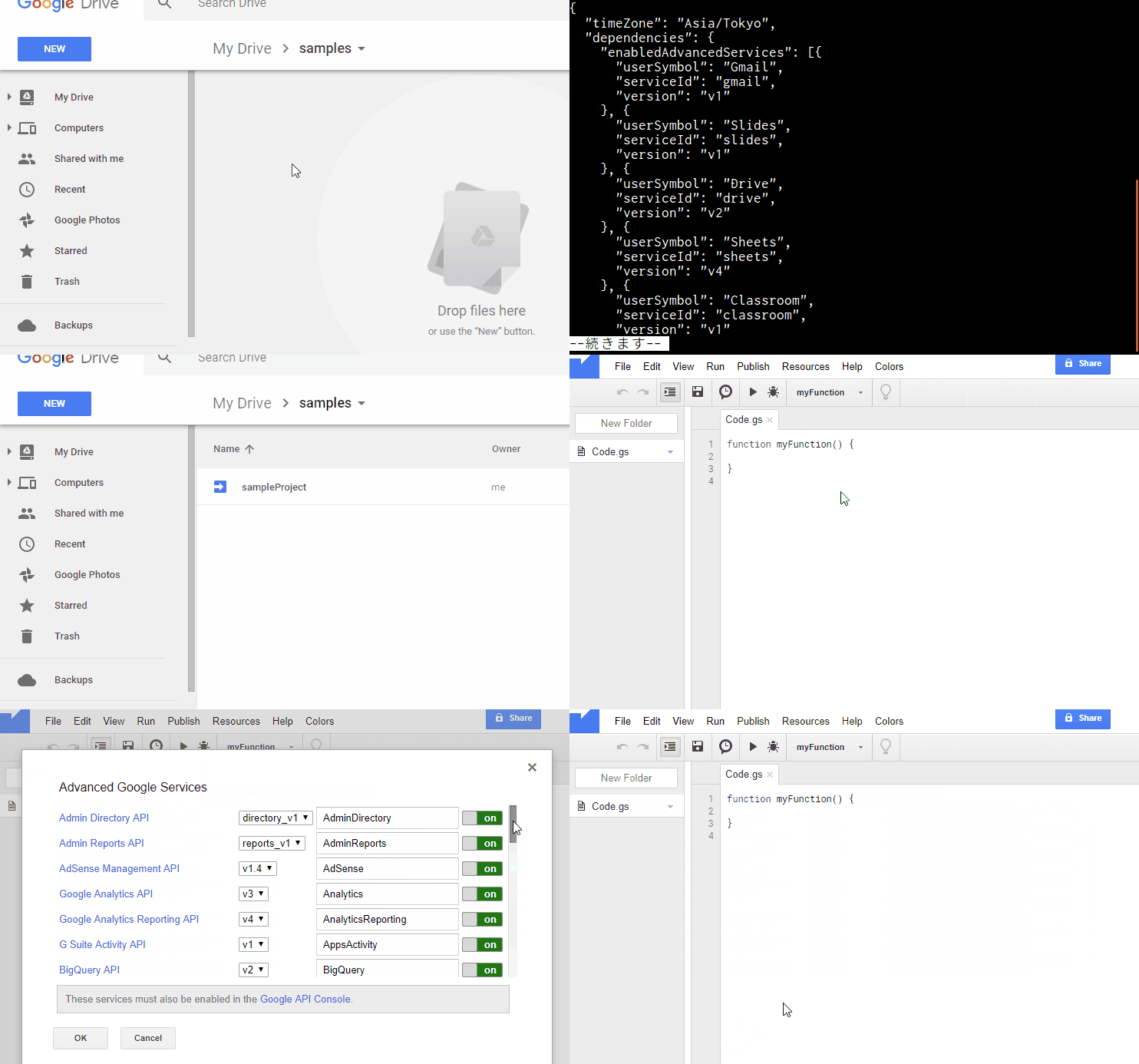
You can check this and download ggsrun at https://github.com/tanaikech/ggsrun.
ggsrun was updated to v.1.3.3
Awesome points of Manifests :
Awesome points of Manifests that I think are below.
ggsrun was updated to v.1.3.2

go-rearrange and gorearrange were updated to v.1.0.2
From this version, data included multi-bytes characters can be used. At Linux, it works fine. At Windows DOS, rearranging and selecting data can be done. But the displayed data is shifted. Although this may be a bug of termbox-go, I don’t know the reason. I’m sorry. On the other hand, data with only single-byte characters works fine. About MAC, I don’t have it. If someone can confirm and tell me it, I’m glad.
go-rearrange and gorearrange were updated to v.1.0.1
- As one of outputs, indexmode (bool) was added. If this is true, the rearranged result is output as the change of index for the source data. For example, if the source data and rearranged data are
["a", "b", "c"] and ["c", "b", "a"], respectively. The output will become [2, 1, 0].
By this, the specification for creating applications will expand.
The detail information and how to get this are https://github.com/tanaikech/gorearrange.
Overview
This is a CLI tool to interactively rearrange a text data on a terminal.
Description
Since I couldn’t find CLI tools for manually rearranging text data, I created this CLI tool.
For this, at first, I created a Golang library go-rearrange.

The detail information and how to get this are https://github.com/tanaikech/gorearrange.
Gists
This sample script is for uploading CSV file as Spreadsheet and modifying permissions using Golang.
I think that the detail information of google-api-go-client is a bit little. The sample scripts are so little. It retrieves most information from only godoc and GitHub. So I publish such sample scripts here. If this is useful for you, I’m glad.
Important points :
- Give mimeType of file that it wants to upload to
options of Media(r io.Reader, options ...googleapi.MediaOption).
- In order to give
options, use googleapi.ContentType().
- Give mimeType of file that it wants to convert, when it uploads it to Google Drive, to
file of Create(file *File).
- In order to give
file, use &drive.File{}.
- For installing permissions, use
&drive.Permission{}. Each parameter is the same to them for Python.
This sample script uses Quickstart. So in order to use this sample script, at first, please do Step 1 and Step 2 of the Quickstart.
Gists
Flow :
In my sample script, the script was made using the Quickstart. The flow to use this sample script is as follows.
- For Go Quickstart, please do Step 1 and Step 2.
- Please put
client_secret.json to the same directory with my sample script.
- Copy and paste my sample script, and create it as new script file.
- Run the script.
- When
Go to the following link in your browser then type the authorization code: is shown on your terminal, please copy the URL and paste to your browser. And then, please authorize and get code.
- Put the code to the terminal.
- When
Done. is displayed, it means that the update of spreadsheet is done.
Request body :
For Spreadsheets.Values.BatchUpdate, BatchUpdateValuesRequest is required as one of parameters. In this case, the range, values and so on that you want to update are included in BatchUpdateValuesRequest. The detail information of this BatchUpdateValuesRequest can be seen at godoc. When it sees BatchUpdateValuesRequest, Data []*ValueRange can be seen. Here, please be carefull that Data is []*ValueRange. Also ValueRange can be seen at godoc. You can see MajorDimension, Range and Values in ValueRange.
ggsrun was updated to v.1.3.1
- Recently, when scripts on local PC is uploaded to Google Drive as a new project, the time to create on Google became a bit long. (I think that this is due to Google Update.) Under this situation, when the script is uploaded, the timeout error occurs while the new project is created using the script. So the time until timeout of fetch was modified from 10 seconds to 30 seconds. By this, when the script is uploaded, no error occurs and the information of the created project is shown.
- You can create a new project on Google Drive using scripts on local PC. The sample command is
ggsrun u -f sample.gs1,sample2.gs,sample3.html -pn newprojectname
You can check this and download ggsrun at https://github.com/tanaikech/ggsrun.
ggsrun was updated to v.1.3.0
- From this version, container-bound scripts can be downloaded. The container-bound script is the script created at the script editor on Google Sheets, Docs, or Forms file.
- In order to download container-bound scripts, the project ID of container-bound scripts is required. The project ID can be retrieved as follows.
- Open the project. And please operate follows using click.
- -> File
- -> Project properties
- -> Get Script ID (This is the project ID.)
- When a project is downloaded, the filename of HTML file had become
.gs. This bug was modified.
The usage is here.
Gists
This is a sample script for exporting a project on Google Drive to local PC using Golang Quickstart. A file with refresh token is saved to the same directory with this script as go-quickstart.json. Before you run this script, please enable Drive API on your Google API console.
Points for exporting project
- In order to export project, both
drive.DriveScriptsScope and drive.DriveScope have to be included in the scope.
- The mimeType for exporting has to be “application/vnd.google-apps.script+json”.
If you already have the file with refresh token, at first, please delete it and run this script. By this, the scopes of refresh token and access token are updated.
ggsrun was updated to v.1.2.2
- For Google Docs (spreadsheet, document, slide and drawing), since I noticed that the revision files would not be able to be retrieved using Drive API v3, I modified this using new workaround.
- The new workaround is to use Drive API v2.
drive.revisions.get of Drive API v2 can retrieve not only the revision list, but also the export links. I thought of the use of the export links. This became the new workaround.
- For the files except for Google Docs, the revision files can be retrieved using Drive API v3.
- The usage is here.
I don’t know when this workaround will not be able to be used. But if this could not be used, I would like to investigate of other method.
gislack is a CLI tool to submit files to both Gist and Slack.
- v1.0.1 (June 30, 2017)
- Some modifications related to error handling.
Please check it out. https://github.com/tanaikech/gislack
Overview
This is a CLI tool to submit files to both Gist and Slack.
Description
When I discuss about developing scripts, I often use Slack. When I submitted a script to Slack, I had saved the script to Gist as a backup. I had done manually this on my browser. Namely, I wanted to be saving the revision of script while I’m discussing about the script at Slack. Recently, I wished this process had been able to be automatically run. So I created this tool.
Overview
This is a Golang library to automatically get an authorization code for retrieving access token using OAuth2.
Description
When it retrieves an access token and refresh token using OAuth2, the code for retrieving them has to be got by authorization on own browser. In order to retrieve the code, in generally, users have to click the authorization button and copy the code on the browser. This library can be automatically got the code by launching HTML server as a redirected server. At first, I have used this for retrieving the code from Google. But recently I noticed that this can be used for other sites. They are Google, GitHub, Slack and so on. This library can be used for creating such applications.
This sample script is for retrieving values from a deep nested JSON. There are 2 patterns. So for these, the benchmark were measured.
Script :
package main

import (
    "encoding/json"
    "testing"
)

const (
    data = `{
      "A_key1": {
        "B_key1": {
          "C_key": "value"
        }
      }
    }`
)

func BenchmarkB1(b *testing.B) {
    b.ResetTimer()
    for i := 0; i < b.N; i++ {
        var p map[string]interface{}
        json.Unmarshal([]byte(data), &p)
        a1 := p["A_key1"]
        a2 := p["A_key1"].(map[string]interface{})["B_key1"]
        a3 := p["A_key1"].(map[string]interface{})["B_key1"].(map[string]interface{})["C_key"]
        _ = a1 // --> map[B_key1:map[C_key:value]]
        _ = a2 // --> map[C_key:value]
        _ = a3 // --> value
    }
}

func BenchmarkB2(b *testing.B) {
    b.ResetTimer()
    for i := 0; i < b.N; i++ {
        var p map[string]interface{}
        json.Unmarshal([]byte(data), &p)
        b1 := p["A_key1"]
        temp, _ := json.Marshal(b1)
        json.Unmarshal(temp, &p)
        b2 := p["B_key1"]
        temp, _ = json.Marshal(b2)
        json.Unmarshal(temp, &p)
        b3 := p["C_key"]
        _ = b1 // --> map[B_key1:map[C_key:value]]
        _ = b2 // --> map[C_key:value]
        _ = b3 // --> value
    }
}
Result :
$ go test -bench .
BenchmarkB1-4             300000              4177 ns/op
BenchmarkB2-4             100000             13619 ns/op
PASS
It was found that the process cost of json.Unmarshal() was high. json.Unmarshal() for test 2 is 3 times larger than that for test 1.
goris is a CLI tool to search for images with Google Reverse Image Search.
Today, it was updated to v1.1.0. Please check it out. https://github.com/tanaikech/goris
When images are matched to a searched image, web pages with matching images are retrieved. These are web pages displayed on Google top page. When this is not used, images are retrieved. This was added as a boolean option. (This was added by a request.)
When a string without no strings is split by strings.Split(), the created slice is the same to the slice created by make(). The length of the slice doesn’t become zero.
Sample script :
package main

import (
    "fmt"
    "strings"
)

func main() {
    sample1a := strings.Split("", " ")
    fmt.Printf("%v, %v, '%v', %v, %+q\n", sample1a, len(sample1a), sample1a[0], len(sample1a[0]), sample1a[0])

    sample1b := make([]string, 1)
    fmt.Printf("%v, %v, '%v', %v, %+q\n", sample1b, len(sample1b), sample1b[0], len(sample1b[0]), sample1b[0])

    var sample2a []string
    fmt.Printf("%v, %v\n", sample2a, len(sample2a))

    sample2b := []string{}
    fmt.Printf("%v, %v\n", sample2b, len(sample2b))
}
Result :
strings.Split() : [], 1, '', 0, ""
make()          : [], 1, '', 0, ""
var                : [], 0
[]string{}      : [], 0
This sample is for changing from “float64” to “int” for values did unmarshal using map[string]interface{}.
When it did unmarshal using map[string]interface{}, a number with “int” was changed to “float64”. And it shows an error as follows.
Error :
panic: interface conversion: interface {} is float64, not int
Sample Script :
It solves using following script.
package main

import (
    "encoding/json"
    "fmt"
    "reflect"
)

func main() {
    data := `{"key": 10}`
    var i map[string]interface{}
    json.Unmarshal([]byte(data), &i)

    val1 := i["key"]
    fmt.Printf("%v, %v\n", val1, reflect.TypeOf(val1)) // 10, float64

    i["key"] = int(i["key"].(float64))
    val2 := i["key"]
    fmt.Printf("%v, %v\n", val2, reflect.TypeOf(val2)) // 10, int
}
Go Playground
This sample is for replacing JSON key by golang.
package main

import (
    "encoding/json"
    "fmt"
)

func main() {
    json1 := `{"key1": "value1"}`

    obj := map[string]interface{}{}
    json.Unmarshal([]byte(json1), &obj)

    fmt.Println(obj) // <-- map[key1:value1]

    obj["key2"] = obj["key1"]
    delete(obj, "key1")

    fmt.Println(obj) // <-- map[key2:value1]
}
This sample script is for splitting command-line arguments by golang. There are 2 types. One is the regular expression is used. Another is that Split() and TrimSpace() are used.
Here, each process speed was compared.
Script :
package main

import (
    "regexp"
    "strings"
    "testing"
)

func BenchmarkB1(b *testing.B) {
    str := "test1.txt, test2.txt"
    b.ResetTimer()
    for i := 0; i < b.N; i++ {
        ar := regexp.MustCompile(`\s*,\s*`).Split(str, -1)
        var result []string
        for _, x := range ar {
            result = append(result, x) // --> 'test.js', 'test2.py'
        }
        _ = result
    }
}

func BenchmarkB2(b *testing.B) {
    str := "test1.txt, test2.txt"
    b.ResetTimer()
    for i := 0; i < b.N; i++ {
        ar := strings.Split(str, ",")
        var result []string
        for _, x := range ar {
            result = append(result, strings.TrimSpace(x)) // --> 'test.js', 'test2.py'
        }
        _ = result
    }
}
Result :
$ go test -bench .
BenchmarkB1-4             100000             13048 ns/op
BenchmarkB2-4            3000000               399 ns/op
PASS
Just as expected, the regular expression was slow. And it’s much slower than that of Split() and TrimSpace().
ggsrun was updated to v.1.2.1
- Configuration file (
ggsrun.cfg) became to be able to be read using the environment variable.
You can check this at here.
Decoding JSON by Golang
func main() {
    data := `{
      "A_key1": {
        "B_key1": {
          "C_key": "value"
        }
      },
      "A_key2": {
        "B_key2": {
          "C_key": "value"
        }
      },
      "A_key3": {
        "B_key3": {
          "C_key": "value"
        }
      },
      "A_key4": {
        "B_key4": {
          "C_key": "value"
        }
      },
      "A_key5": {
        "B_key5": {
          "C_key": "value"
        }
      }
    }`
    var p interface{}
    json.NewDecoder(strings.NewReader(data)).Decode(&p)
    fmt.Println(p)
}
Go Playground
Dynamically Creating JSON by Golang
obj := map[string]interface{}{}
obj["hoge"] = "huga"
fmt.Println(obj)
Go Playground
Retrieving Response Headers by Golang
res, _ := client.Do(req)
contentType := res.Header.Get("Content-Type")
contentLength := res.Header.Get("Content-Length")
ggsrun was updated to v.1.2.0
- Added a command for retrieving revision files on Google Drive.
- Some modifications.
You can check this at here.
goris is a CLI tool to search for images with Google Reverse Image Search.
Today, it was updated to v1.0.1. Please check it out. https://github.com/tanaikech/goris
When number of retrieved URLs is smaller than number of default output, an error had occurred. This was fixed.
This sample script dynamically creates nested JSON objects.
Script
obj := map[string]interface{}{}
for i := 1; i <= 5; i++ {
    value := map[string]interface{}{
        fmt.Sprintf("B_key%d", i): map[string]interface{}{
            "C_key": "value",
        },
    }
    obj[fmt.Sprintf("A_key%d", i)] = value
}
Result
{
  "A_key1": {
    "B_key1": {
      "C_key": "value"
    }
  },
  "A_key2": {
    "B_key2": {
      "C_key": "value"
    }
  },
  "A_key3": {
    "B_key3": {
      "C_key": "value"
    }
  },
  "A_key4": {
    "B_key4": {
      "C_key": "value"
    }
  },
  "A_key5": {
    "B_key5": {
      "C_key": "value"
    }
  }
}
gogauth is a CLI tool to easily retrieve access token for using APIs on Google.
I thought that if the access token can easily retrieve, it may be useful for users who can use various convenience Google APIs. So I created this. Also this can be used for testing sample script like the demo. If this will be helpful for you, I’m glad.
Today, it was updated to v2.0.1. Please check it out. https://github.com/tanaikech/gogauth
Updated ggsrun to v.1.1.0
Added a command for updating existing project on Google Drive. One of scripts in the project can be also updated.
https://github.com/tanaikech/ggsrun
Overview
This is a CLI tool to search for images with Google Reverse Image Search.
Motivation
Because I had wanted to search for images with an image URL and file on my terminal, I created this. This can download images from searched image URLs.
The detail information and how to get this are https://github.com/tanaikech/goris.
Overview
This is a CLI tool to execute Google Apps Script (GAS) on a terminal.
Motivation
Will you want to develop GAS using CoffeeScript on your local PC? Generally, when we develop GAS, we have to login to Google using own browser and develop it using Javascript on the Script Editor. Recently, I have wanted to have more convenient local-environment for developing GAS. So I created this “ggsrun”.
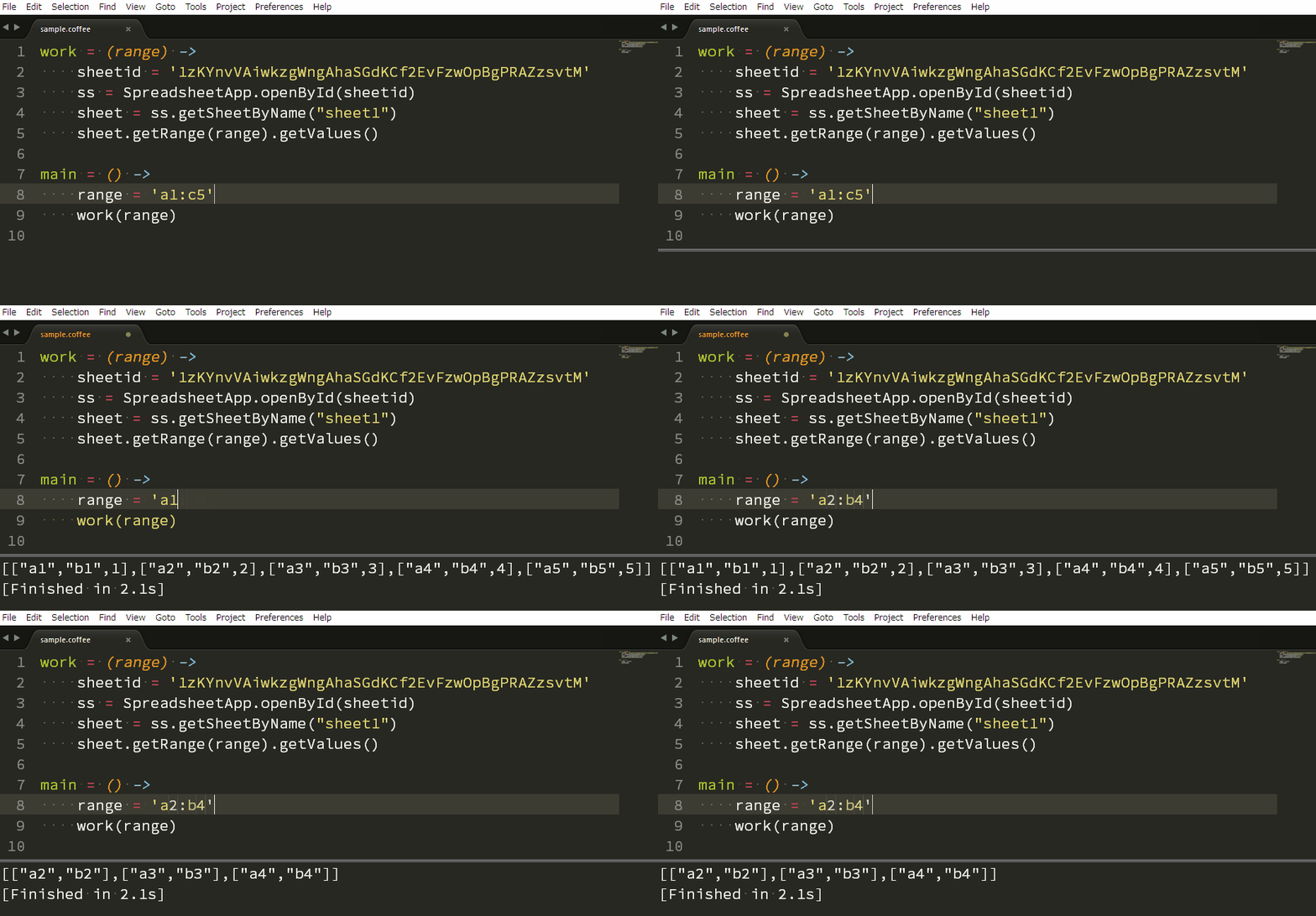
gogauth is a CLI tool to retrieve easily access token for using APIs on Google.
Today, it was updated with big changes. Please check it out.
https://github.com/tanaikech/gogauth
Released a CLI tool for easily retrieving accesstoken from Google OAuth2. The title is gogauth. When I have seen stackoverflow, I knew that it is difficult to retrieve accesstoken from Google OAuth2. So I made this.
Features of this CLI tool are as follows.
-
Retrieves easily accesstoken from Google OAuth2 for using Drive API.
-
If you have PhantomeJS, this retrieves “code” from Google using it. So you don’t need to launch your browser for retrieving “code”.