Gists
Abstract
This study proposes a workaround to address the Gemini API’s current inability to directly process web content from URLs. By utilizing Google Apps Script, the method extracts relevant information from a specified URL and feeds it into the API for summarization. This approach offers a solution for generating comprehensive summaries from web-based content until the API’s limitations are resolved.
Introduction
While Gemini API offers powerful text generation capabilities, it currently faces limitations in directly accessing and processing web content from URLs. When prompted to summarize an article at a specific URL like Summarize the article at the following URL. https://###, the API often returns an error message indicating its inability to retrieve the necessary information. This limitation arises from the API’s current design, which may not be equipped to handle web requests and parse HTML content.
Gists
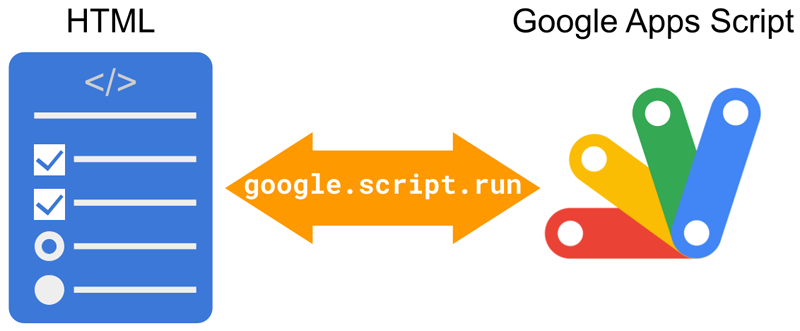
At the Google Apps Script project, the values can be transferred from HTML to Google Apps Script using google.script.run with Javascript. In this case, unfortunately, the values of all types cannot be transferred. In the official document, it says as follows. Ref
Most types are legal, but not Date, Function, or DOM element besides form; see description
Legal parameters are JavaScript primitives like a Number, Boolean, String, or null, as well as JavaScript objects and arrays that are composed of primitives, objects, and arrays. A form element within the page is also legal as a parameter, but it must be the function’s only parameter. Requests fail if you attempt to pass a Date, Function, DOM element besides a form, or other prohibited type, including prohibited types inside objects or arrays. Objects that create circular references will also fail, and undefined fields within arrays become null. Note that an object passed to the server becomes a copy of the original. If a server function receives an object and changes its properties, the properties on the client are not affected.
Gists
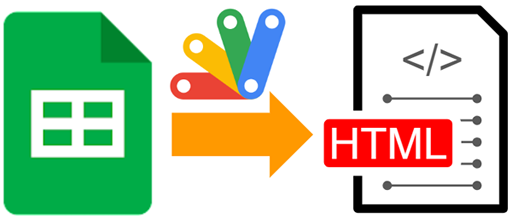
This is a sample script for converting Google Spreadsheet to an HTML table using Google Apps Script.
There is the case that it is required to convert a sheet in a Google Spreadsheet to an HTML table. For example, there might be a situation that a sheet in a Google Spreadsheet is sent as an email including an HTML table. And, there might be a situation in which a sheet in a Google Spreadsheet is published to an HTML page including the converted HTML table. I have published the method for achieving this before. Ref But, in that case, the column width, the row height, merged cells, and the images in the cells couldn’t be used. When those are included in the script, the script becomes complicated. So, I couldn’t include it. But, recently, I have come up with a simple method for achieving this. In this post. I would like to introduce a sample script for converting a sheet in a Google Spreadsheet to HTML.
Gists
Today, I discussed with Riël Notermans an issue with the HTML form with the input tab of type="file" with google.script.run. Through this discussion, the reason for this issue could be found. When you use the input tab of type="file" in the HTML form, and you want to send the file content with google.script.run, I thought that this post might be useful for other users. So, I posted it here.
Gists
Introduction
When we use HTML in the Google Apps Script project, in order to show the values from the Google Apps Script side, the HTML template is used. When I used the HTML template with a large value, I understood that the process cost can be reduced by devising a script. In this report, I would like to introduce the process cost of the HTML template using the benchmark.
Gists
This is a sample script for simply converting HTML to plain text using Google Apps Script.
Sample values
<div id="sample1">sample text1</div>
<div id="sample2">sample text2</div>
<ul id="sample3">
  <li>sample list 1</li>
  <li>sample list 2</li>
</ul>
<table id="sample4">
  <tbody>
    <tr>
      <td>a1</td>
      <td>b1</td>
      <td>c1</td>
    </tr>
    <tr>
      <td>a2</td>
      <td>b2</td>
      <td>c2</td>
    </tr>
  </tbody>
</table>
Text (output value)
sample text1
sample text2

   - sample list 1
   - sample list 2

a1 b1 c1
a2 b2 c2
Sample script
function myFunction() {
  const sampleHTML = `<div id="sample1">sample text1</div>
<div id="sample2">sample text2</div>
<ul id="sample3">
  <li>sample list 1</li>
  <li>sample list 2</li>
</ul>
<table id="sample4">
  <tbody>
    <tr>
      <td>a1</td>
      <td>b1</td>
      <td>c1</td>
    </tr>
    <tr>
      <td>a2</td>
      <td>b2</td>
      <td>c2</td>
    </tr>
  </tbody>
</table>`;
  const temp = GmailApp.createDraft("", "", "", { htmlBody: sampleHTML });
  const plainText = temp.getMessage().getPlainBody();
  temp.deleteDraft();
  console.log(plainText);
}
- This method uses
GmailApp.createDraft for converting HTML to plain text. When a draft email is created with GmailApp.createDraft by giving an HTML body, when the message content is retrieved with getPlainBody(), the plain text is retrieved. This method uses this situation.
- When this sample script is run, the result in “Sample values” section can be obtained.
Note
- This method is a simple conversion from HTML to plain text. So I’m not sure whether this method can be used for all HTML data. Please be careful about this.
References
Gists
Overview
When // in template literal is used in a HTML file in script editor, it is used as a comment start.
For example, when above script is used in a HTML file at the script editor, ;" of const sample =`//`; is used as the comment.
Description
I would like to explain about this bug using the following sample flow.
Flow
-
Create new Spreadsheet and open the script editor. In this explanation, please use the container-bound script.
Gists
This is a sample script for parsing HTML using Google Apps Script. When HTML data is converted to Google Document, the HTML data can be parsed and be converted to Google Document. In this case, the paragraphs, lists and tables are included. From this situation, I thought that this situation can be used for parsing HTML using Google Apps Script. So I could came up with this method.
In the Sheet API, the HTML data can be put to the Spreadsheet with the PasteDataRequest. But unfortunately, in this case, I couldn’t distinguish between the body and tables.
Gists
This is a sample script for selecting files in Google Drive using HTML select box for Google Apps Script.
Feature
Feature of this sample.
- It is a simple and space saving.
- When the folder is selected, the files in the folder are shown.
- When the file is selected, the ID of file is retrieved. Users can use this ID at GAS.
- When a folder is opened, all files in the folder are cached. By this, the second access of the folder is faster.
- It doesn’t retrieve all files in Google Drive at once, so the read of files from Google Drive becomes the minimum necessary.
I will use this for applications that users need to select files on Google Drive.