Check any PDF, draft, or image against 1,000 criteria at once—with zero output tokens
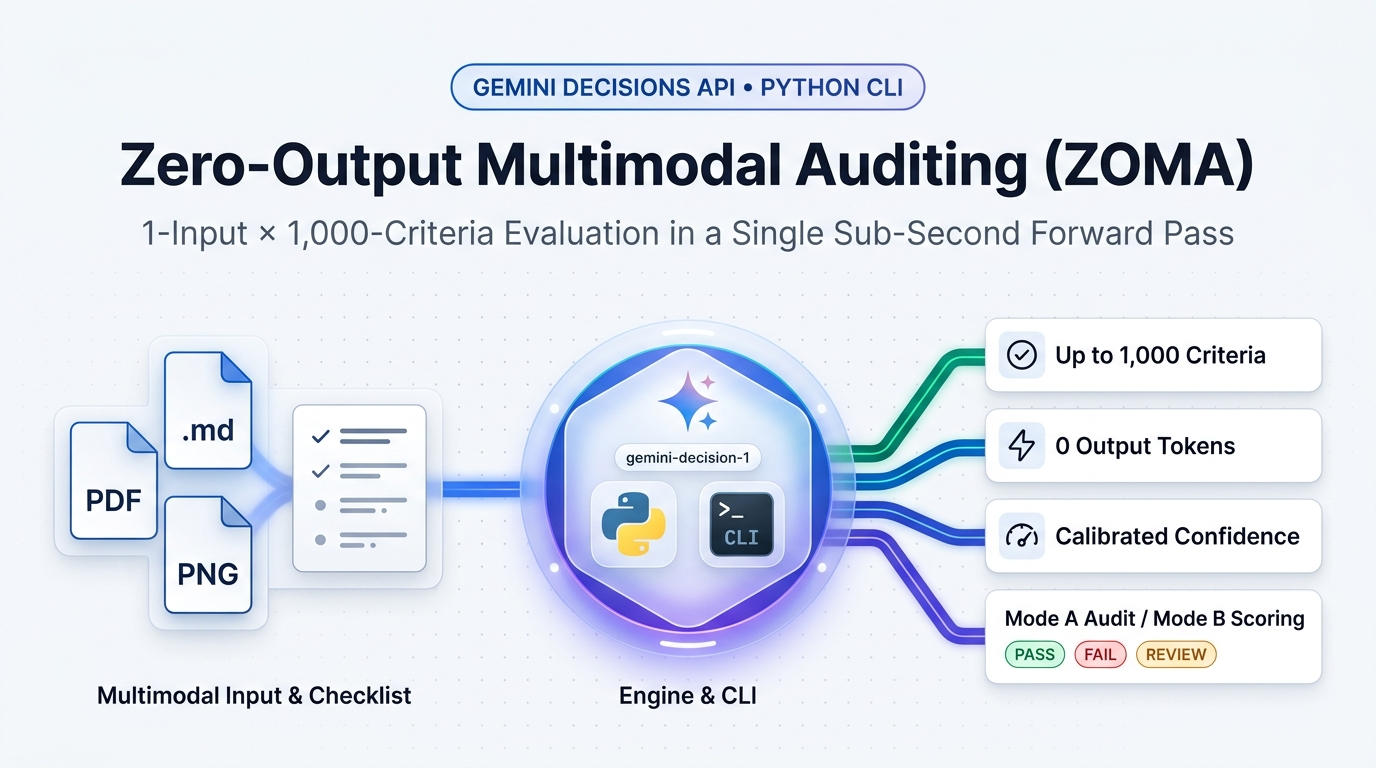
Introduction
In my previous article, “Zero-Output-Token AI in Google Apps Script with Gemini Decisions API” Ref (source repository Ref), I demonstrated how Google DeepMind’s Gemini Decisions API (POST https://generativelanguage.googleapis.com/v1beta/decisions, powered by gemini-decision-1) Ref fits Google Workspace automation—covering Gmail inbox labeling, model cascade routing, and a Google Sheets PDF compliance audit. Among those examples, the PDF compliance audit drew an especially strong response, and I received inquiries about it from readers across many different fields.
The origin of that idea was actually very personal: before turning it into a Google Sheets demo, I had been using the Decisions API in my own daily writing workflow to check my own research papers, technical articles, manuscripts, and drafts against a self-defined set of review criteria all at once, surfacing issues instantaneously. When developers first encounter a classification endpoint like the Decisions API, the natural mental model is “Many-Inputs × Few-Labels”—classifying a stream of emails or support tickets into three to five categories. Flipping that geometry to “1-Input × up to 1,000-Criteria”—sending one rich multimodal artifact (a PDF, research paper, article manuscript, or ad creative) once and evaluating it against up to 1,000 independent questions in a single forward pass—turned out to be a usage pattern that most users had never envisioned.
Because of that response, I decided to write this dedicated follow-up article focused exclusively on this technique, which I refer to as Zero-Output Multimodal Auditing (ZOMA). Because gemini-decision-1 evaluates all questions against the shared input simultaneously without autoregressive text decoding Ref, ZOMA produces strictly zero output tokens ($0.00 output cost, with input tokens billed once at $0.10 per 1M input tokens) Ref while returning calibrated probabilities (0.01 to 0.99), discrete choices, and ordinal rubric scores (0–4). Moving beyond Google Apps Script into a universal, dependency-light Python 3 CLI published at gemini-decisions-api-python Ref, this article presents a reusable ZOMA auditing and weighted-scoring architecture and validates it across five live multimodal use cases (83 total criteria across Markdown, PDF, and PNG inputs). While I designed the core scenario and evaluation criteria for each of the five use cases myself, the sample input documents used to demonstrate and reproduce each run were generated with Gemini via samples/generate_samples.py Ref so that anyone can reproduce every benchmark without proprietary files; every latency, token count, probability, score, and cost figure reported in this article comes directly from live API runs, and you can immediately swap in your own local files and custom checklists.
In Plain English: What Is ZOMA?
Imagine handing a 20-page vendor contract, a research manuscript draft, an advertising banner, a student essay, or a grant proposal to a meticulous reviewer along with a structured checklist—and receiving every checkbox verdict, every 0–4 quality rating, and a clear flag on any ambiguous clause that needs human judgment back in under one second, for a fraction of a cent. That is Zero-Output Multimodal Auditing (ZOMA). Instead of asking an AI chatbot to write long prose explanations one question at a time, ZOMA sends your document once, evaluates dozens or hundreds of independent checklist rules simultaneously, and lets deterministic Python code handle all final math and pass/fail decisions.
Key Terms in Plain English
- Single Forward Pass & Zero Output Tokens: Standard AI chatbots generate answers one word (token) at a time, which adds latency and output billing. A single forward pass reads your document once and returns structured numeric answers directly, generating zero written text and zero output-token cost.
- Calibrated Probability (
0.01–0.99): A reliability-tuned percentage expressed from0.01(1% likely “Yes”) to0.99(99% likely “Yes”). When the model is genuinely unsure (for example,0.72), the score sits in the middle instead of pretending to be 99% certain. - Question Types (
noul,choice,score): The three structured question formats supported by the Decisions API—noulfor Yes/No checks,choicefor picking one label from a fixed list, andscorefor rating quality on an ordered rubric such as0to4. - OCR-Free Multimodal Input: Sending PDFs and images (like PNG banners) directly to the AI model as-is, without running a separate Optical Character Recognition (OCR) or PDF-to-text converter first.
- CLI, JSON/YAML & Dry-Run: A Command-Line Interface (CLI) is a lightweight terminal program; JSON and YAML are plain-text formats used to write your checklist rules; and
--dry-runchecks your files and rules locally before making any paid API call. - Knock-Out Gate: A mandatory eligibility requirement (such as a maximum grant budget cap) where failing that single rule disqualifies a submission immediately, regardless of how high its overall quality score is.
1. Why Gemini Decisions API Excels at ZOMA & Architecture
Low latency and low cost are the most immediately visible advantages of gemini-decision-1, yet its deeper architectural strengths are what make Zero-Output Multimodal Auditing (ZOMA) production-grade across legal, editorial, visual, and academic domains Ref:
- Sub-Second Single Forward-Pass Latency: Because the model evaluates all questions in a single prefill forward pass (reading the document once without generating text word-by-word) without autoregressive token-by-token decoding, end-to-end latency remains flat and sub-second (
497.4–856.4 mslive measured across 14–20 criteria) instead of scaling linearly with output length. - Ultra-Low Cost with Strictly Zero Output Tokens: Shared document input tokens are billed once at
$0.10per 1M input tokens Ref, while output and thinking tokens remain strictly0($0.00output cost), cutting input volume by over 92% compared to sequential per-criterion calls. - Mathematically Calibrated Probabilities & Native Confidence Gating: Unlike generative LLMs whose self-reported verbal confidence is often poorly calibrated,
gemini-decision-1returns statistically calibrated probabilities (0.01–0.99) and confidence scores, enabling reliable automatedNEEDS_REVIEWescalation thresholds (such as0.85). - Zero JSON Parse Failures & Closed-Set Schema Guarantees: Because no free-form text is decoded into JSON strings, malformed JSON, hallucinated enum values, and schema drift are structurally impossible across
noul,choice(2–255 options), andscore(2–255 ordered rubric tiers) primitives Ref. - High-Density Parallel Batching (Up to 1,000 Independent Questions): A single request evaluates up to 1,000 independent criteria against the exact same shared context without cross-question prompt contamination or attention degradation from massive compound instructions.
- 262,144-Token Unified Multimodal Context (OCR-Free): A single shared
inputaccepts up to 262,144 tokens (256K) across mixed modalities—text, JSON, PDFs, images, audio, and video Ref—allowing native inspection of multi-page PDFs and high-resolution ad creatives without external OCR or PDF-to-text pipelines. - High Reproducibility for Programmatic Control Flow: Without autoregressive sampling drift or variable thinking-token traces, probability outputs remain highly repeatable across runs, making
gemini-decision-1a dependable upstream signal provider for deterministic downstream software logic.
Separation of Concerns
A common problem in LLM-based evaluation pipelines is asking a single generative model to read a document, judge 20 criteria, apply custom business weights, check hard eligibility rules, and sum the final score in one autoregressive JSON response. When AI judgment and arithmetic are mixed together, models exhibit silent summation drift, inconsistent threshold enforcement, and brittle JSON formatting errors.
To prevent these problems by design, our Python CLI enforces a strict two-layer separation of concerns, illustrated in Figure 1.
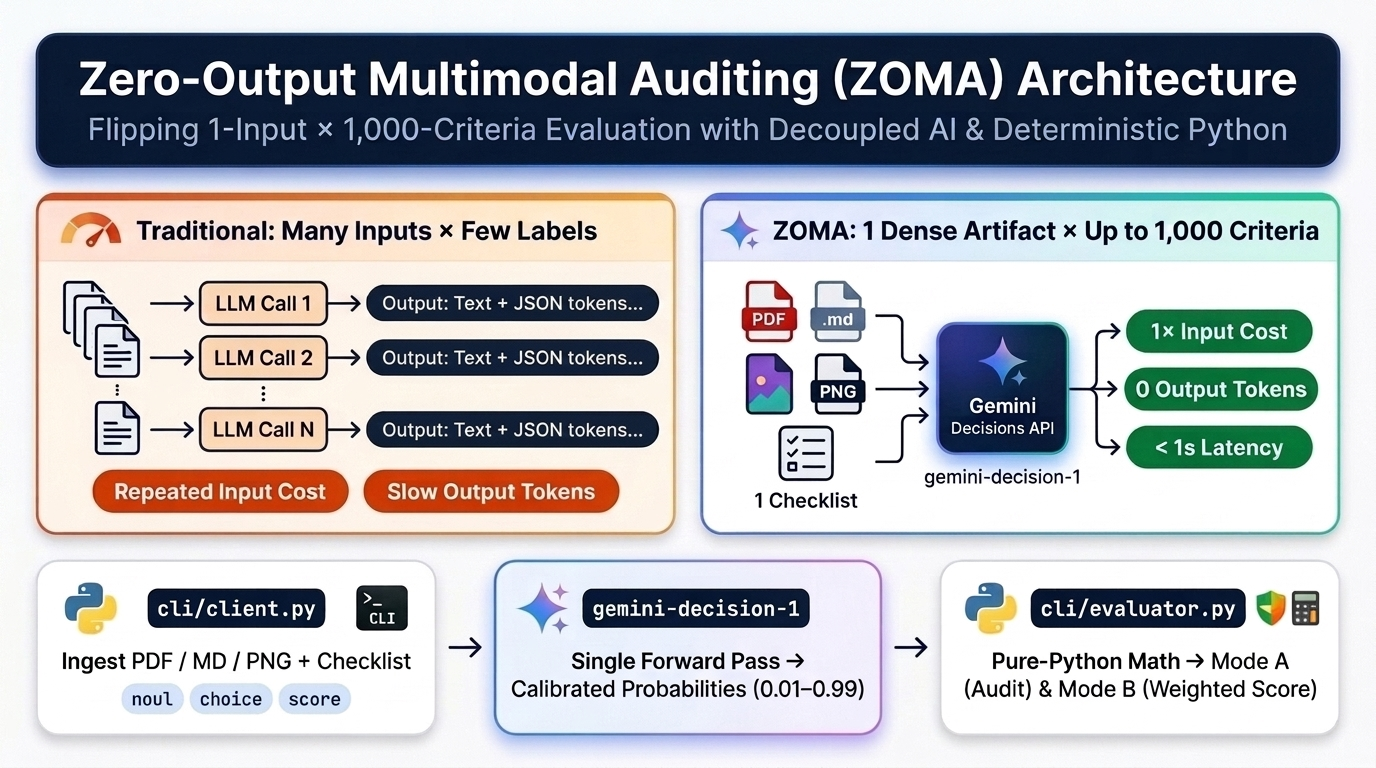 Figure 1: Shifting from sequential autoregressive LLM loops to 1-Input × up to 1,000-Criteria evaluation with strict separation between
gemini-decision-1 inference (client.py) and deterministic Python aggregation (evaluator.py).
As shown in Figure 1, the pipeline divides responsibility across three focused modules:
- Stateless Multimodal Transport (
cli/client.py) Ref: Reads a local.md,.txt,.pdf,.png,.jpg,.jpeg, or.webpfile once, Base64-encodes binary documents and images natively without OCR middleware (packaging PDFs and images directly for the API without separate text-extraction tools), authenticates strictly via thex-goog-api-keyHTTP header, automatically chunks checklists exceeding 1,000 questions into compliant batches, applies bounded exponential backoff on HTTP 429/5xx, and normalizes proto-JSON response fields into typed Python dictionaries. - Zero-Output-Token Semantic Inference (
gemini-decision-1): Evaluates every criterion independently against the shared input in one forward pass, returning calibratednoulprobabilities (0.01–0.99),choiceprobability distributions, orscoreexpected values and ordinal bucket distributions—with0output tokens generated. - Deterministic Evaluation Engine (
cli/evaluator.py) Ref: Operates completely offline with zero network I/O. It applies exact threshold rules, risk-flag inversions (expected: "no"), hard knock-out gates, weighted linear scaling, negative penalty deductions, and borderline/low-confidence escalation in pure Python—verified offline by the Stage-3 boundary stress test suite (an automated offline check that verifies the math handles edge cases like zero scores or borderline ties)cli/test_evaluator_stress.pyRef.
This decoupling guarantees that LLM arithmetic hallucination is structurally impossible: the AI model only produces calibrated per-criterion signals, while Python owns every threshold comparison, weighted sum, and pass/fail verdict. Table 1 compares the two deterministic operating modes built into evaluator.py alongside a traditional autoregressive LLM loop.
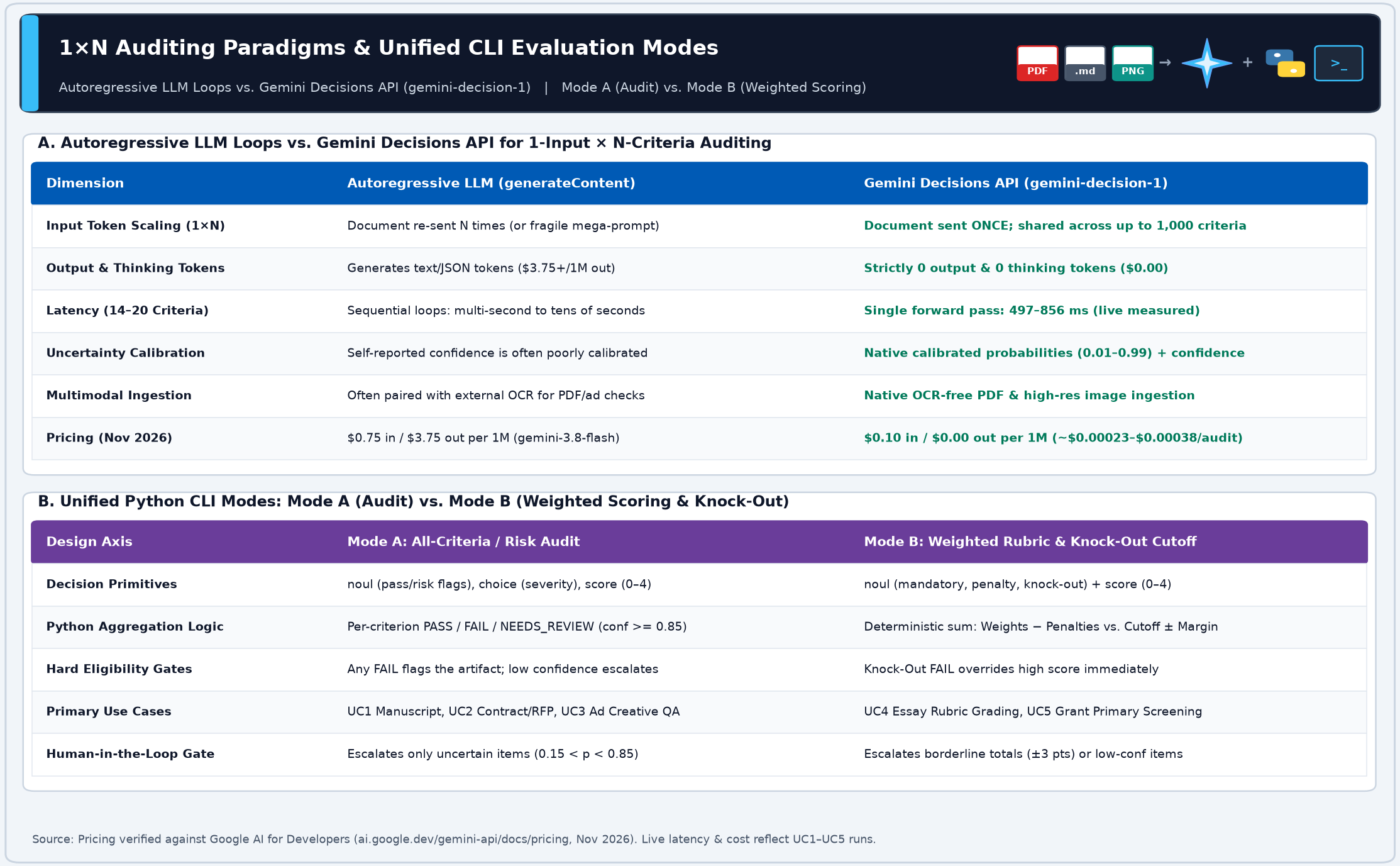 Table 1: Comparison of Naive Autoregressive LLM Loops vs. Gemini Decisions API Mode A (
audit) and Mode B (weighted_scoring) across token scaling, output tokens, arithmetic determinism, and human-in-the-loop gating.
Table 1 highlights why a single checklist schema can drive two distinct enterprise patterns:
- Mode A (
audit): Designed for binary compliance, pre-flight linting, and risk scanning. Eachnoulcriterion specifiesexpected: "yes"(required safeguard) orexpected: "no"(prohibited risk flag). Any signal whose confidence falls belowconfidence_threshold(default0.85, i.e.,0.15 < P < 0.85) is routed automatically toNEEDS_REVIEWrather than guessed. Forchoicecriteria, explicitfail_choicesorreview_choicestriggerFAILorNEEDS_REVIEW; forscorecriteria, expected scores are gated againstpass_minandfail_max. - Mode B (
weighted_scoring): Designed for rubric grading, grant screening, and procurement scoring. Criteria can be marked asknockout: true(hard eligibility gates where aFAILimmediately disqualifies the submission regardless of points, and low confidence forcesNEEDS_REVIEW), positive-weightnoulorscoredimensions (where an ordinal0–4score contributes(score / max_scale) * weightpoints), or negative-weightnoulpenalty flags. If the final total falls within±borderline_marginofcutoff_score, or if too many items exhibit low confidence (max_low_conf_for_auto), the engine escalates the overall verdict toNEEDS_REVIEW.
Mode A & Mode B End-to-End Workflows
Before diving into CLI commands and live numbers, Figure 2 and Figure 3 map the five end-to-end workflows we evaluated across both operating modes.
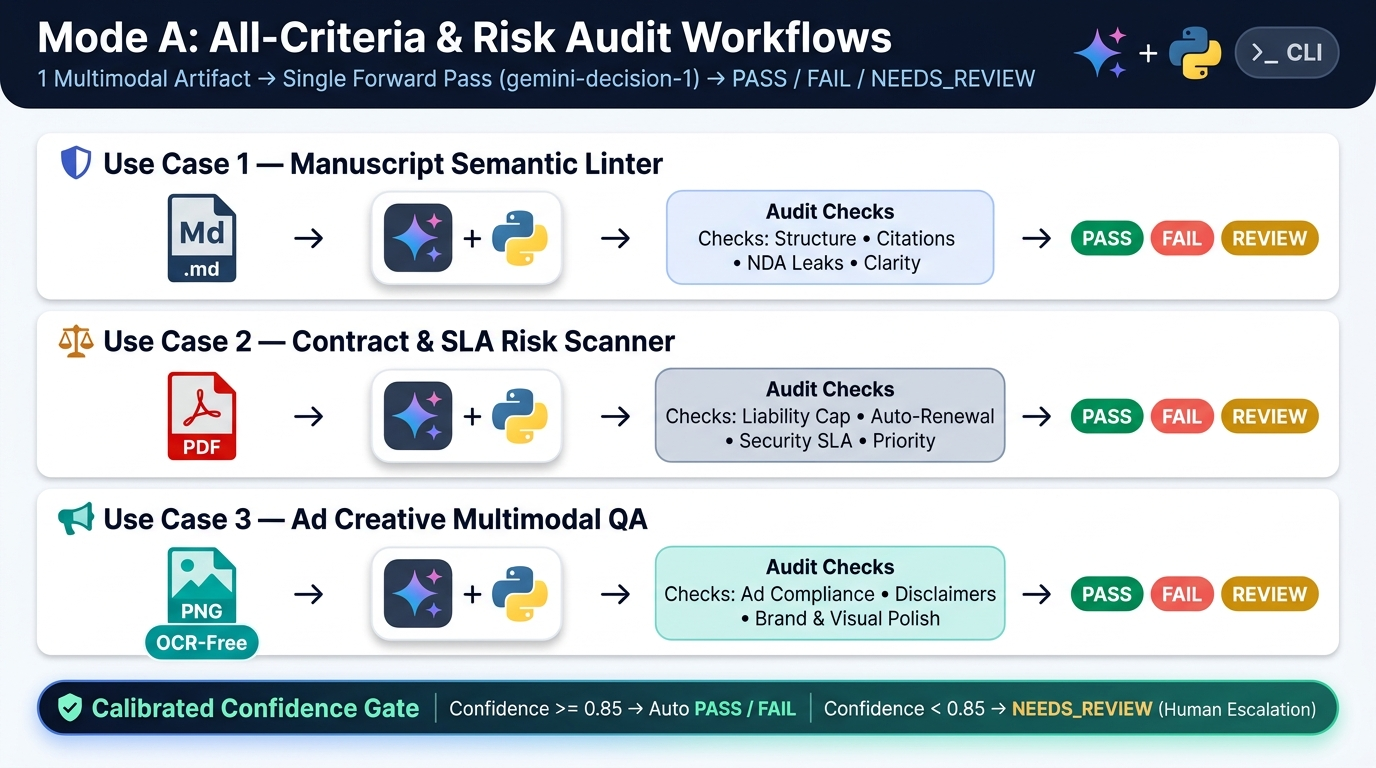 Figure 2: End-to-end Mode A (
audit) pipelines for UC1 (Markdown Manuscript Linter), UC2 (Multi-Page Vendor Contract PDF Risk Scanner), and UC3 (High-Resolution Ad Creative PNG QA), each executed in a single API batch.
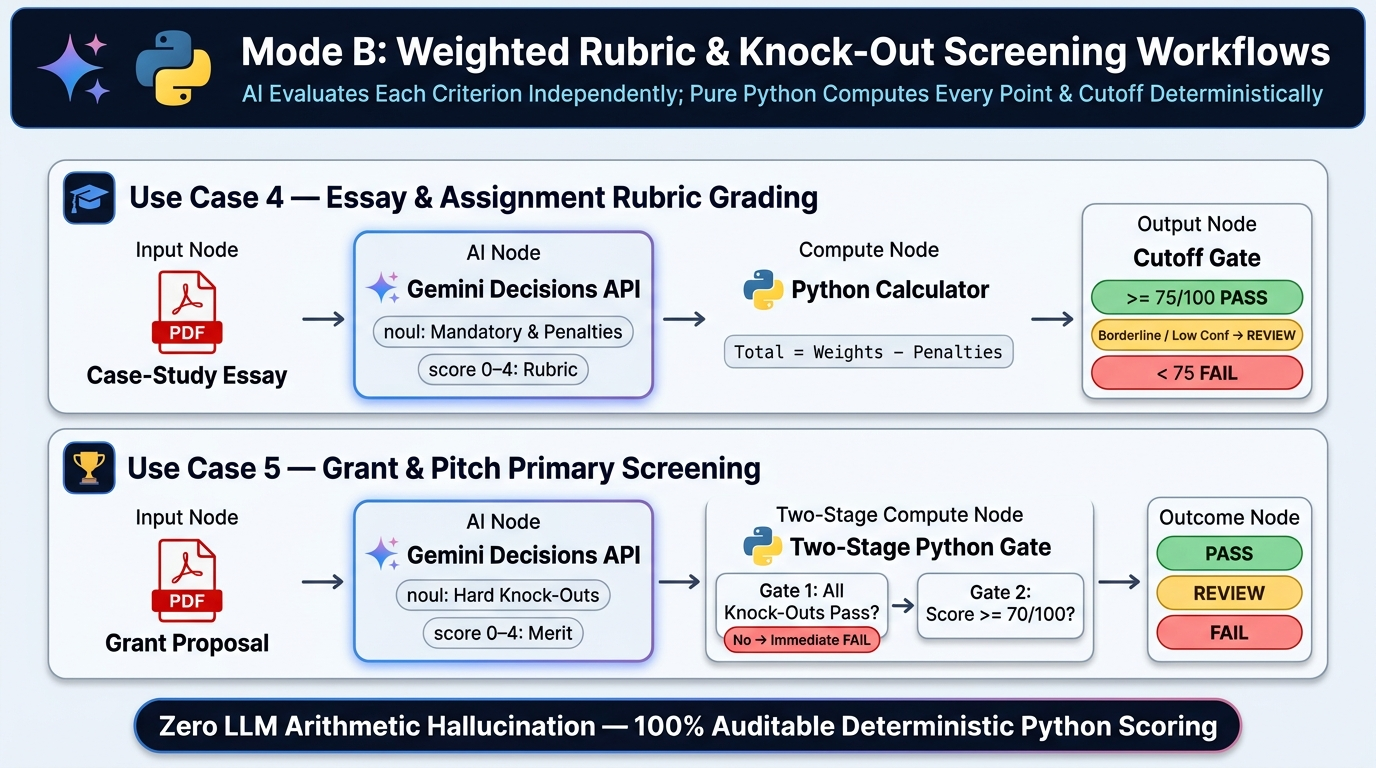 Figure 3: Mode B (
weighted_scoring) execution pipelines for UC4 (Cybersecurity Essay Rubric Grading) and UC5 (R&D Grant Proposal Knock-Out + Weighted Screening), where Python deterministically computes final totals and cutoff gates.
2. Quickstart & Reusable Python CLI Usage
All scripts, sample inputs, checklists, and saved live results are published in tanaikech/gemini-decisions-api-python Ref. The CLI requires only Python 3, requests, and PyYAML (requirements.txt Ref). Clone the repository, install dependencies, and export your Gemini API key once (the client sends the key solely in the x-goog-api-key header and never embeds it in URLs):
Not a programmer? Here is what the commands below actually do in 3 steps:
- Step 1 — One-Time Setup: Download the free tool folder, install its two lightweight Python helper libraries, and store your Gemini API key securely in your terminal session.
- Step 2 — Define or Pick Your Checklist: Choose one of the ready-made checklist files (or edit your own plain-text JSON/YAML rules) describing what to check, score, or flag.
- Step 3 — Audit Any Document: Point the tool at any local Markdown draft, PDF, or PNG image and get a structured pass/fail or weighted score report in under a second.
git clone https://github.com/tanaikech/gemini-decisions-api-python.git
cd gemini-decisions-api-python
pip install -r requirements.txt
export GEMINI_API_KEY="your-api-key-here"
Every audit or scoring workflow is defined declaratively in a single JSON or YAML checklist file. Below is a compact excerpt from a Mode B (weighted_scoring) checklist showing how a hard knock-out gate, a weighted binary criterion, and a weighted ordinal score rubric coexist in the same schema:
{
  "name": "UC5: R&D Grant Proposal Knock-Out + Weighted Screening",
  "mode": "weighted_scoring",
  "confidence_threshold": 0.85,
  "cutoff_score": 70.0,
  "borderline_margin": 3.0,
  "max_low_conf_for_auto": 2,
  "criteria": [
    {
      "id": "ko_budget_cap",
      "category": "Knock-Out Eligibility",
      "label": "[KO] Budget <= $250,000",
      "type": "noul",
      "knockout": true,
      "expected": "yes",
      "instructions": "Is the total requested grant funding less than or equal to the $250,000 program cap?"
    },
    {
      "id": "has_itemized_budget",
      "category": "Completeness",
      "label": "Itemized Budget Breakdown (+5)",
      "type": "noul",
      "expected": "yes",
      "weight": 5.0,
      "instructions": "Does the proposal include an itemized budget breakdown whose line items clearly reconcile to the requested total?"
    },
    {
      "id": "technical_merit_score",
      "category": "Merit Rubric",
      "label": "Technical Merit & Architecture (0-4, max 20)",
      "type": "score",
      "weight": 20.0,
      "max_scale": 4,
      "instructions": "Rate the technical soundness, hardware/software feasibility, and engineering clarity of the proposed sensor network.",
      "criteria": [
        "0: Technically infeasible or undefined",
        "1: High-level concept lacking engineering specifics",
        "2: Plausible design with missing power, telemetry, or calibration details",
        "3: Solid, practical engineering design with concrete BOM, power, and filtering specs",
        "4: Exceptional, field-ready architecture with rigorous calibration and open hardware specs"
      ]
    }
  ]
}
Before spending any API calls, you can run the offline zero-data stress test (cli/test_evaluator_stress.py Ref) and validate any input file and checklist schema locally with --dry-run:
python3 cli/test_evaluator_stress.py
python3 cli/decisions_audit.py \
  --input samples/uc1_manuscript_draft.md \
  --checklist samples/uc1_checklist.json \
  --dry-run
Running all five live use cases uses the exact same CLI entry point (cli/decisions_audit.py Ref), switching only --input, --checklist, and optional flags (--resolution high for images, --format table|markdown|json, or --confidence-threshold):
# UC1: Manuscript / Technical Document Semantic Linter (Markdown, Mode A)
python3 cli/decisions_audit.py \
  --input samples/uc1_manuscript_draft.md \
  --checklist samples/uc1_checklist.json \
  --output results/uc1_result.json

# UC2: Vendor SaaS Contract & SLA Risk Scanner (Multi-page PDF, Mode A)
python3 cli/decisions_audit.py \
  --input samples/uc2_vendor_contract.pdf \
  --checklist samples/uc2_checklist.json \
  --output results/uc2_result.json

# UC3: Ad Creative OCR-Free Multimodal QA (High-res PNG, Mode A)
python3 cli/decisions_audit.py \
  --input samples/uc3_ad_creative.png \
  --checklist samples/uc3_checklist.json \
  --resolution high \
  --output results/uc3_result.json

# UC4: Student / Training Essay Weighted Rubric Grading (PDF, Mode B)
python3 cli/decisions_audit.py \
  --input samples/uc4_student_essay.pdf \
  --checklist samples/uc4_checklist.json \
  --output results/uc4_result.json

# UC5: R&D Grant Proposal Knock-Out + Weighted Screening (PDF, Mode B)
python3 cli/decisions_audit.py \
  --input samples/uc5_grant_proposal.pdf \
  --checklist samples/uc5_checklist.json \
  --output results/uc5_result.json
To adapt the CLI to your own documents, swap --input for any local Markdown, plain text, PDF, or image file, and edit a JSON/YAML checklist with your organization’s rules. Adding --format markdown outputs a ready-to-paste report for GitHub pull requests, Notion pages, or CI/CD job summaries, while --format json emits clean machine-readable JSON so autonomous AI agents—such as Google Antigravity, Claude Code, Gemini CLI, or OpenAI Codex—can invoke cli/decisions_audit.py directly from their terminal tool (or wrap it as an agent skill) to self-audit drafts, reports, and visual assets in under a second.
3. Mode A Live Walkthrough & Empirical Results
Mode A (audit) targets high-precision defect detection across text, multi-page PDFs, and raw visual creatives. Following the three single-batch pipelines mapped in Figure 2, we examine each Mode A use case individually alongside its dedicated live test results infographic (Figure 4, Figure 5, and Figure 6).
How to read the live numbers in Sections 3 and 4:
- Required checks (
expected: "yes"): We want the document to contain this element, so a high probability (p >= 0.85) meansPASS, while a very low probability (p <= 0.15) meansFAIL(missing requirement). - Risk & defect flags (
expected: "no"): We want this problem to be absent, so a low probability (p <= 0.15) meansPASS(safe), while a high probability (p >= 0.85) meansFAIL(risk or violation detected). - Human-review zone (
0.15 < P < 0.85): Whenever the model’s confidence is below0.85, the tool refuses to guess and routes that criterion toNEEDS_REVIEWfor a human reviewer. - Rubric scores (
0–4, e.g.,3.17 / 4): Rather than forcing a blunt whole number, the model returns a probability distribution across levels0through4and computes the weighted average (expected score) for fine-grained grading.
Use Case 1: Manuscript & Technical Document Semantic Linter (uc1_manuscript_draft.md)
What this test checks in plain English: Before submitting a technical paper or article draft, can ZOMA catch hidden confidentiality leaks, missing citations, and vague claims alongside structural quality checks in half a second?
In Use Case 1, a 5,034-byte Markdown systems engineering preprint draft (samples/uc1_manuscript_draft.md Ref, “Adaptive Cache-Coherence Prefetching for Multi-Region Edge Workers”) was audited against 18 criteria (16 noul + 2 score) defined in samples/uc1_checklist.json Ref in a single batch (saved output: results/uc1_result.json Ref). The live call completed in 497.37 ms (0 retries) using 2,562 input tokens and 0 output tokens (estimated cost $0.000256), saving 17 sequential API calls. The overall verdict was FAIL (13 PASS, 3 FAIL, 2 NEEDS_REVIEW), as detailed in Figure 4.
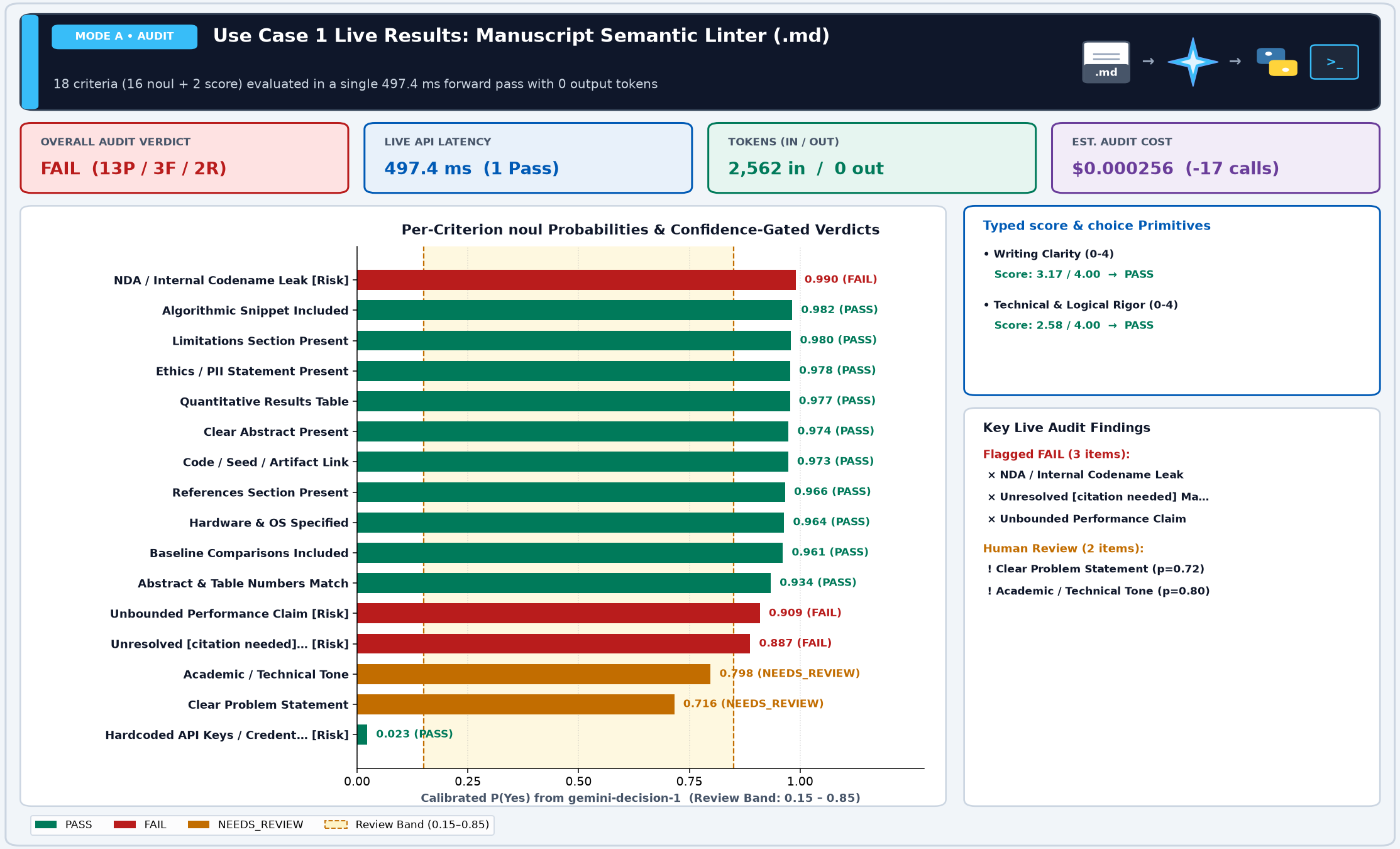 Figure 4: Live
gemini-decision-1 audit results for UC1 (uc1_manuscript_draft.md, 18 criteria, 497.4 ms, 2,562 input tokens, 0 output tokens, $0.000256), highlighting all three planted blockers caught, 13 passed checks, and 2 calibrated human-review escalations.
As visualized in Figure 4, the live run separated structural strengths, planted blockers, and subjective gray zones cleanly in under half a second:
- 13 Required & Security Checks Passed with High Confidence: Core publication sections passed decisively (
p = 0.934–0.982), includinghas_code_snippet(p = 0.982),has_limitations(p = 0.980),has_ethics_privacy(p = 0.978),has_quantitative_table(p = 0.977),has_abstract(p = 0.974),has_code_or_seed(p = 0.973),has_references(p = 0.966),has_reproducible_env(p = 0.964),has_baselines(p = 0.961), andconsistent_numbers(p = 0.934). The security risk flagcontains_hardcoded_secrets(expected: "no") also passed cleanly (p = 0.023, confidence0.977). - All 3 Planted Blockers Caught (
FAIL): The draft intentionally included an internal project codename and NDA customer identifier (Project Nighthawk / NorthStar Financial Corp, NDA-2026-041), an unresolved[citation needed]marker, and an unquantified “nearly zero tail latency overhead” claim.gemini-decision-1flagged all three risk criteria (expected: "no") above the0.85threshold:leak_confidential_nda(p = 0.990),unbounded_vague_claim(p = 0.909), andunresolved_citation_todo(p = 0.887). - 2 Calibrated
NEEDS_REVIEWEscalations: Two nuanced qualitative criteria fell inside the0.15 < P < 0.85uncertainty band and were safely routed to a human editor instead of forced into a binary verdict:has_problem_statement(p = 0.716) anduses_professional_tone(p = 0.798). - Continuous Quality Rubric Scores: Both
0–4ordinal scores cleared thepass_min = 2.50bar—writing_clarity_scoreachieved 3.17 / 4 (P(3) = 0.469,P(4) = 0.369) whilelogical_rigor_scorescored 2.58 / 4 (P(3) = 0.446,P(2) = 0.338), accurately reflecting strong technical structure tempered by the unverified performance claim.
UC1 Summary (Input → Findings): Feeding a 5 KB Markdown preprint draft and an 18-item pre-publication checklist into a single 497 ms pass immediately confirmed 13 required sections and security checks, caught all 3 planted blockers (an NDA client leak, an unresolved [citation needed], and an unquantified performance claim), and routed 2 nuanced tone/problem-statement items to a human editor instead of guessing.
Use Case 2: Vendor SaaS Contract & SLA Risk Scanner (uc2_vendor_contract.pdf)
What this test checks in plain English: When procurement receives a multi-page software vendor contract PDF, can ZOMA verify security guarantees while flagging unfair liability caps, auto-renewal traps, and borderline clauses in under a second?
In Use Case 2, a 53,951-byte multi-page vendor SaaS contract PDF (samples/uc2_vendor_contract.pdf Ref) was ingested natively as a document block—without any PDF-to-text extraction library—and evaluated against 20 criteria (17 noul + 2 choice + 1 score) in samples/uc2_checklist.json Ref (saved output: results/uc2_result.json Ref) in 856.42 ms (0 retries) using 3,809 input tokens (2,769 text + 1,040 image tokens) and 0 output tokens (estimated cost $0.000381), saving 19 sequential API calls. The overall verdict was FAIL (9 PASS, 10 FAIL, 1 NEEDS_REVIEW), shown in Figure 5.
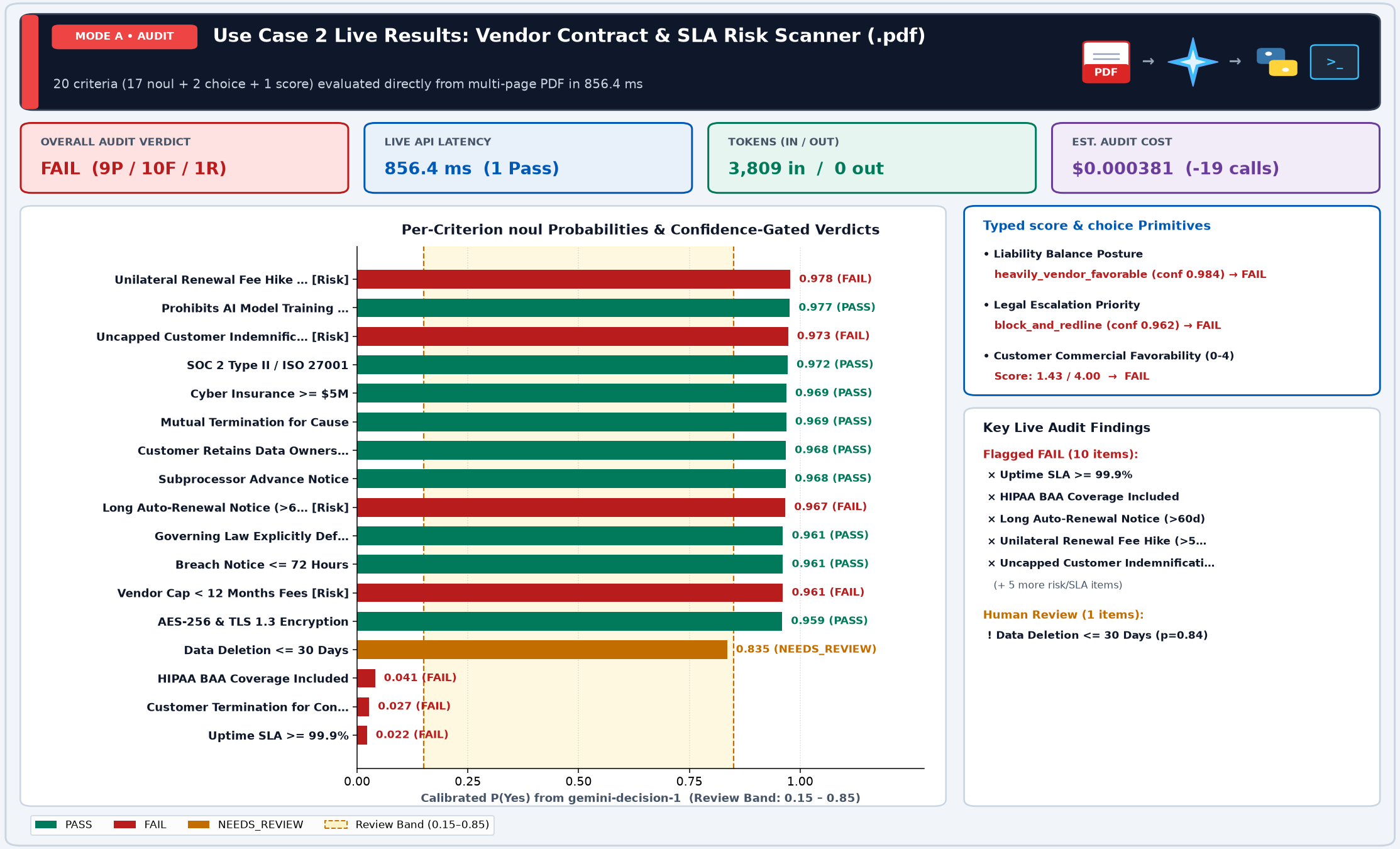 Figure 5: Live
gemini-decision-1 audit results for UC2 (uc2_vendor_contract.pdf, 20 criteria, 856.4 ms, 3,809 input tokens, 0 output tokens, $0.000381), contrasting 9 verified security safeguards against 10 commercial/legal FAIL verdicts and 1 borderline review clause.
Figure 5 demonstrates why multi-axis legal screening benefits from combining noul, choice, and score questions in a single forward pass:
- 9 Security & Governance Safeguards Verified (
PASS): Every baseline security control present in the contract passed with high certainty (p = 0.959–0.977):no_ai_training_on_data(p = 0.977),soc2_or_iso27001(p = 0.972),cyber_insurance_5m(p = 0.969),termination_for_cause(p = 0.969),customer_owns_data(p = 0.968),subprocessor_notice(p = 0.968),breach_notice_72h(p = 0.961),governing_law_specified(p = 0.961), andencryption_at_rest_transit(p = 0.959). - 10 Commercial, SLA & Legal Red Flags Caught (
FAIL): Three required protections were absent—sla_meets_99_9(p = 0.022),termination_for_convenience(p = 0.027), andhipaa_baa_included(p = 0.041). Simultaneously, all four prohibited risk clauses (expected: "no") triggered decisively:risk_renewal_price_hike>5% (p = 0.978),risk_uncapped_customer_indemnity(p = 0.973),risk_auto_renewal_long_notice>60 days (p = 0.967), andrisk_low_vendor_liability_cap<12 months of fees (p = 0.961). Bothchoicequestions selected fail classes with over 96% confidence—liability_posture = heavily_vendor_favorable(confidence0.984) andnegotiation_priority = block_and_redline(confidence0.962)—andcommercial_favorability_scorelanded at 1.43 / 4 (belowfail_max = 1.50). - 1 Borderline Clause Escalated (
NEEDS_REVIEW):data_deletion_30dreturnedp = 0.835, sitting just0.015below the0.85confidence gate. Rather than auto-approving a subtle post-termination deletion clause,evaluator.pyflagged it for legal counsel review.
UC2 Summary (Input → Findings): Feeding a multi-page vendor SaaS contract PDF and a 20-item legal/SLA checklist directly (with no PDF text extractor) verified 9 baseline security safeguards in 856 ms while flagging 10 commercial/legal red flags (low uptime SLA, missing HIPAA BAA, uncapped customer indemnity, long auto-renewal, block_and_redline priority) and safely escalating 1 borderline 30-day data-deletion clause for legal review.
Use Case 3: Ad Creative OCR-Free Multimodal QA (uc3_ad_creative.png)
What this test checks in plain English: Looking directly at a finished advertising banner image with no OCR tool, can ZOMA confirm clean branding and layout while catching prohibited financial promises and unreadable fine-print disclaimers?
In Use Case 3, a 101,539-byte FinTech advertising banner PNG (samples/uc3_ad_creative.png Ref) was passed directly to gemini-decision-1 with --resolution high—with zero OCR preprocessing—against 16 criteria (14 noul + 2 score) in samples/uc3_checklist.json Ref (saved output: results/uc3_result.json Ref). The single API call completed in 836.97 ms (0 retries) using 2,286 input tokens (1,186 text + 1,100 image tokens) and 0 output tokens (estimated cost $0.000229), saving 15 sequential API calls. The overall verdict was FAIL (11 PASS, 5 FAIL, 0 NEEDS_REVIEW), as illustrated alongside the audited creative thumbnail in Figure 6.

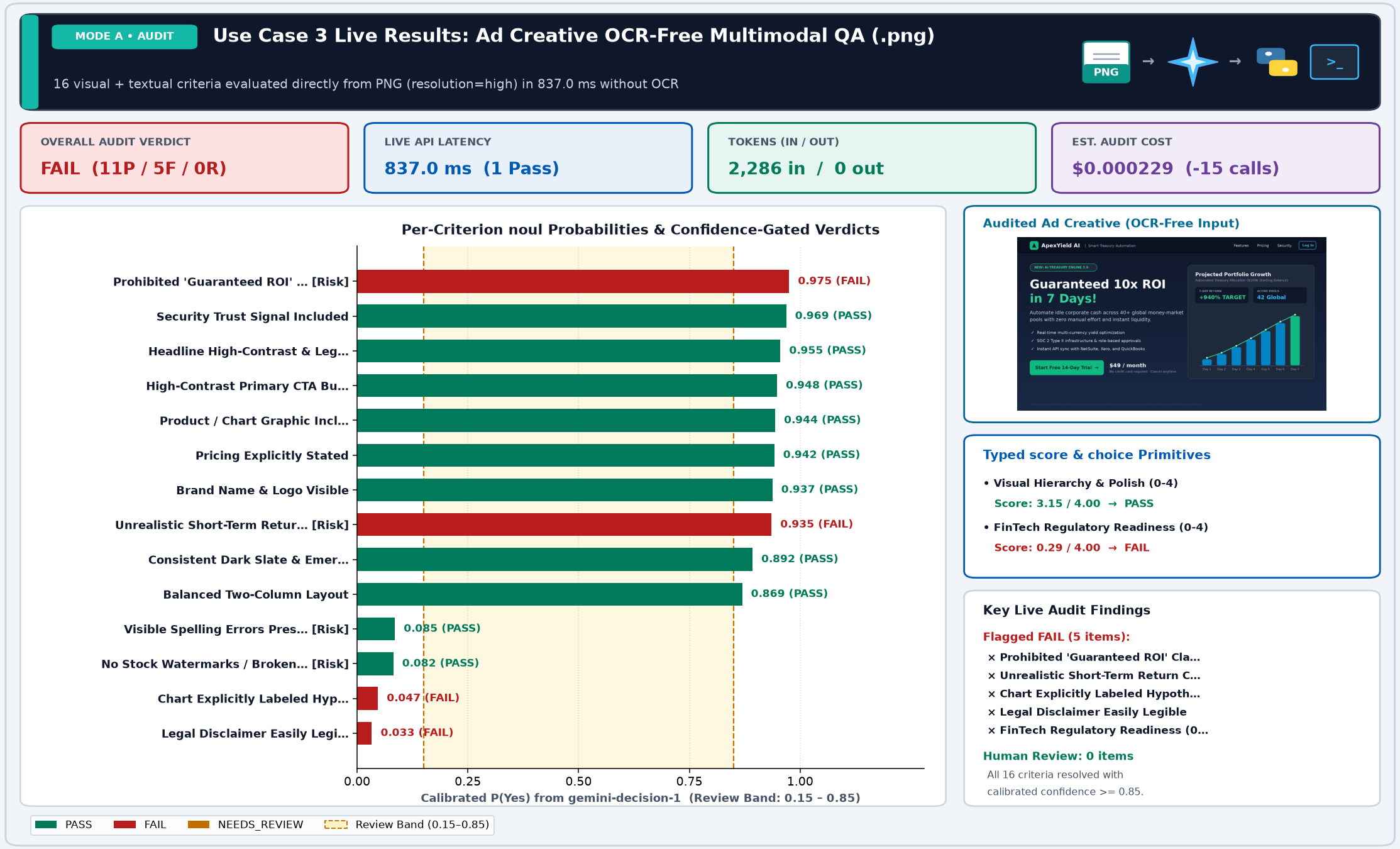 Figure 6: Live
gemini-decision-1 multimodal QA results for UC3 (uc3_ad_creative.png with embedded sample thumbnail, 16 criteria, 837.0 ms, 2,286 input tokens, 0 output tokens, $0.000229), separating strong visual design polish (3.15/4) from severe FinTech regulatory violations (0.29/4).
As shown in Figure 6, native high-resolution image ingestion captured both layout quality and fine-print regulatory failures simultaneously:
- 11 Brand, Accessibility & Design Checks Passed (
PASS):mentions_security_soc2(p = 0.969),headline_legible_contrast(p = 0.955),clear_cta_button(p = 0.948),has_data_visual(p = 0.944),pricing_transparent(p = 0.942),brand_logo_visible(p = 0.937),dark_mode_brand_palette(p = 0.892), andclean_uncluttered_layout(p = 0.869) all passed, while both visual defect risk flags (expected: "no") stayed cleanly low:no_stock_watermarks(p = 0.082, confidence0.918) andno_typos_visible(p = 0.085, confidence0.915).visual_hierarchy_scoreearned 3.15 / 4. - 5 FinTech Regulatory & Disclosure Violations Caught (
FAIL): Without any OCR step,gemini-decision-1caught the prohibited “Guaranteed ROI” headline (claim_guaranteed_roi:p = 0.975,exp=no), the unrealistic short-term return claim (unrealistic_return_metric:p = 0.935,exp=no), the unlabeled hypothetical chart (chart_labeled_hypothetical:p = 0.047,exp=yes), and the obscured low-contrast legal disclaimer footer (disclaimer_legible_contrast:p = 0.033,exp=yes). Consequently,regulatory_readiness_scorefell to 0.29 / 4 (P(0) = 0.763), failing decisively belowfail_max = 1.50. - Why 0
NEEDS_REVIEWEscalations Occurred: Every binary criterion resolved at or above0.869confidence (minimum0.869onclean_uncluttered_layout), leaving zero ambiguous signals—an ideal property for automated pre-flight ad-network moderation queues.
UC3 Summary (Input → Findings): Passing a high-resolution FinTech ad banner PNG and a 16-item creative QA checklist with zero OCR confirmed strong visual polish (3.15 / 4 hierarchy, 11 passed brand/design checks) in 837 ms while catching all 5 severe FinTech regulatory violations ("Guaranteed ROI" promise, unrealistic return claim, unlabeled hypothetical chart, illegible disclaimer, and 0.29 / 4 regulatory readiness) with zero ambiguous escalations.
4. Mode B Live Walkthrough & Empirical Results
Mode B (weighted_scoring) moves beyond pass/fail checklists into quantitative rubric grading and multi-stage eligibility screening. Following the deterministic aggregation and knock-out pipelines illustrated in Figure 3, we walk through each Mode B live evaluation with its dedicated scoring breakdown infographic (Figure 7 and Figure 8).
Use Case 4: Cybersecurity Case Study Weighted Rubric Grading (uc4_student_essay.pdf)
What this test checks in plain English: Given a student’s PDF case study and a 100-point grading rubric, can ZOMA check required topics, rate four quality dimensions, check for penalties, and compute an exact, hallucination-free grade in Python?
In Use Case 4, a 52,224-byte student cybersecurity case study PDF (samples/uc4_student_essay.pdf Ref) was graded against a 100-point rubric (samples/uc4_checklist.json Ref; saved output: results/uc4_result.json Ref) containing 14 criteria: 6 mandatory element checks worth +5.0 pts each (30.0 pts), 4 ordinal 0–4 rubric dimensions totaling 70.0 pts, and 4 negative penalty flags (-10.0 to -15.0 pts), with a 75.0 cutoff and ±3.0 borderline margin. The single Decisions API call finished in 702.58 ms (0 retries) using 3,261 input tokens (2,221 text + 1,040 image tokens) and 0 output tokens (estimated cost $0.000326), saving 13 sequential API calls. The deterministic final score was 86.17 / 100.0 (86.2%), yielding PASS, as detailed in Figure 7.
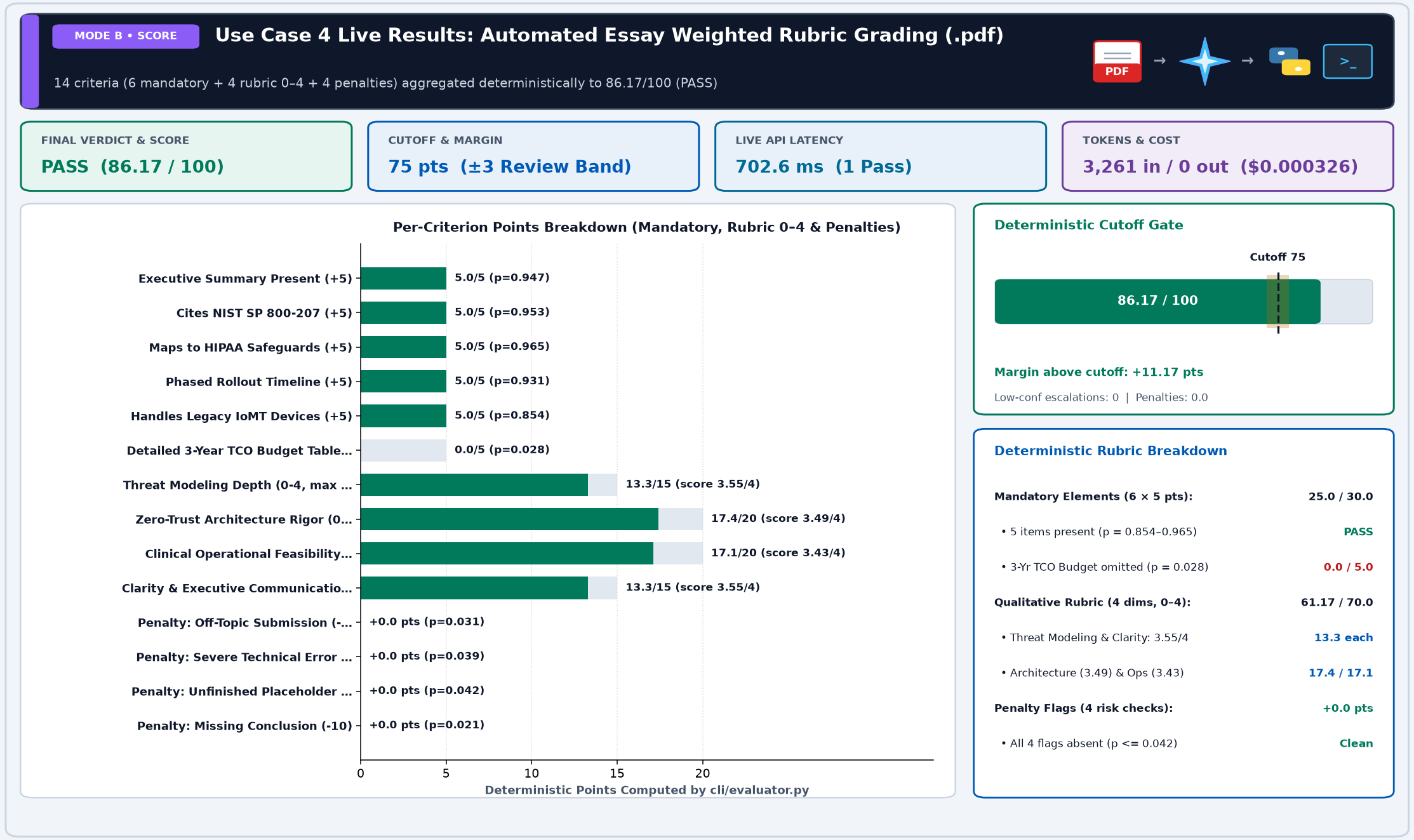 Figure 7: Live Mode B rubric grading breakdown for UC4 (
uc4_student_essay.pdf, 14 criteria, 702.6 ms, 3,261 input tokens, 0 output tokens, $0.000326), showing 25.0/30.0 mandatory points, 61.17/70.0 rubric points, 0.0 penalties, and a final score of 86.17/100.0 vs. the 75.0 cutoff.
Figure 7 breaks down every exact point calculated offline by evaluator.py:
- Mandatory Elements (
25.00 / 30.00 pts): Five required elements passed with full+5.0credit—addresses_hipaa(p = 0.965),references_nist_800_207(p = 0.953),has_exec_summary(p = 0.947),has_phased_roadmap(p = 0.931), andaddresses_legacy_iomt(p = 0.854). The student omitted a detailed 3-year TCO budget table (has_3yr_tco_budget:p = 0.028, confidence0.972), whichevaluator.pydeterministically markedFAIL(0.0 / 5.0 pts). - Weighted Ordinal Rubric Dimensions (
61.17 / 70.00 pts): Python converted each0–4expected score linearly via(score / 4.0) * weight:threat_modeling_score(3.548 / 4→ 13.31 / 15.0 pts),architecture_rigor_score(3.487 / 4→ 17.43 / 20.0 pts),operational_feasibility_score(3.427 / 4→ 17.13 / 20.0 pts), andwriting_coherence_score(3.547 / 4→ 13.30 / 15.0 pts). Summing25.00 + 13.3055 + 17.4333 + 17.1343 + 13.3004yields 86.1735 pts (86.17 / 100.0), clearing the75.0cutoff by +11.17 pts—well outside the±3.0borderline review band. - Zero False Penalties & Zero Low-Confidence Escalations: All four negative penalty flags stayed tightly near zero—
penalty_missing_conclusion(p = 0.021),penalty_off_topic(p = 0.031),penalty_factual_blunder(p = 0.039), andpenalty_placeholder_text(p = 0.042)—deducting0.0pts. Because everynoulitem exceeded0.85confidence and everyscoreitem concentrated its top-2 adjacent probability mass (P(3) + P(4) = 0.920–0.958) above0.85,low_confidence_itemswas empty (0 / 2cap), enabling safe automated grading.
UC4 Summary (Input → Findings): Grading a student’s cybersecurity case-study PDF against a 14-item, 100-point rubric took 703 ms and revealed 5 of 6 mandatory elements present (25.0 / 30.0, catching the omitted 3-year TCO budget table), strong qualitative scores (61.17 / 70.0), and zero penalty deductions—deterministically yielding PASS at 86.17 / 100.0 (+11.17 pts above the 75.0 cutoff).
Use Case 5: R&D Grant Proposal Knock-Out + Weighted Screening (uc5_grant_proposal.pdf)
What this test checks in plain English: When screening an R&D grant application PDF, can ZOMA enforce strict pass/fail eligibility rules first and then score technical merit, impact, and budget realism against a 70-point cutoff?
In Use Case 5, a 60,088-byte R&D grant proposal PDF (samples/uc5_grant_proposal.pdf Ref) was screened against 15 criteria (samples/uc5_checklist.json Ref; saved output: results/uc5_result.json Ref): 4 hard knock-out eligibility gates (weight = 0.0, mandatory pass), 6 completeness/impact binary checks (+5.0 pts each = 30.0 pts), 4 ordinal merit rubric scores (70.0 pts total), and 1 conflict-of-interest / ethics penalty flag (-15.0 pts), against a 70.0 cutoff and ±3.0 borderline margin. The single API call completed in 769.60 ms (0 retries) using 3,339 input tokens (2,299 text + 1,040 image tokens) and 0 output tokens (estimated cost $0.000334), saving 14 sequential API calls. The proposal cleared all 4 knock-out gates and scored 91.40 / 100.0 (91.4%), returning PASS, as presented in Figure 8.
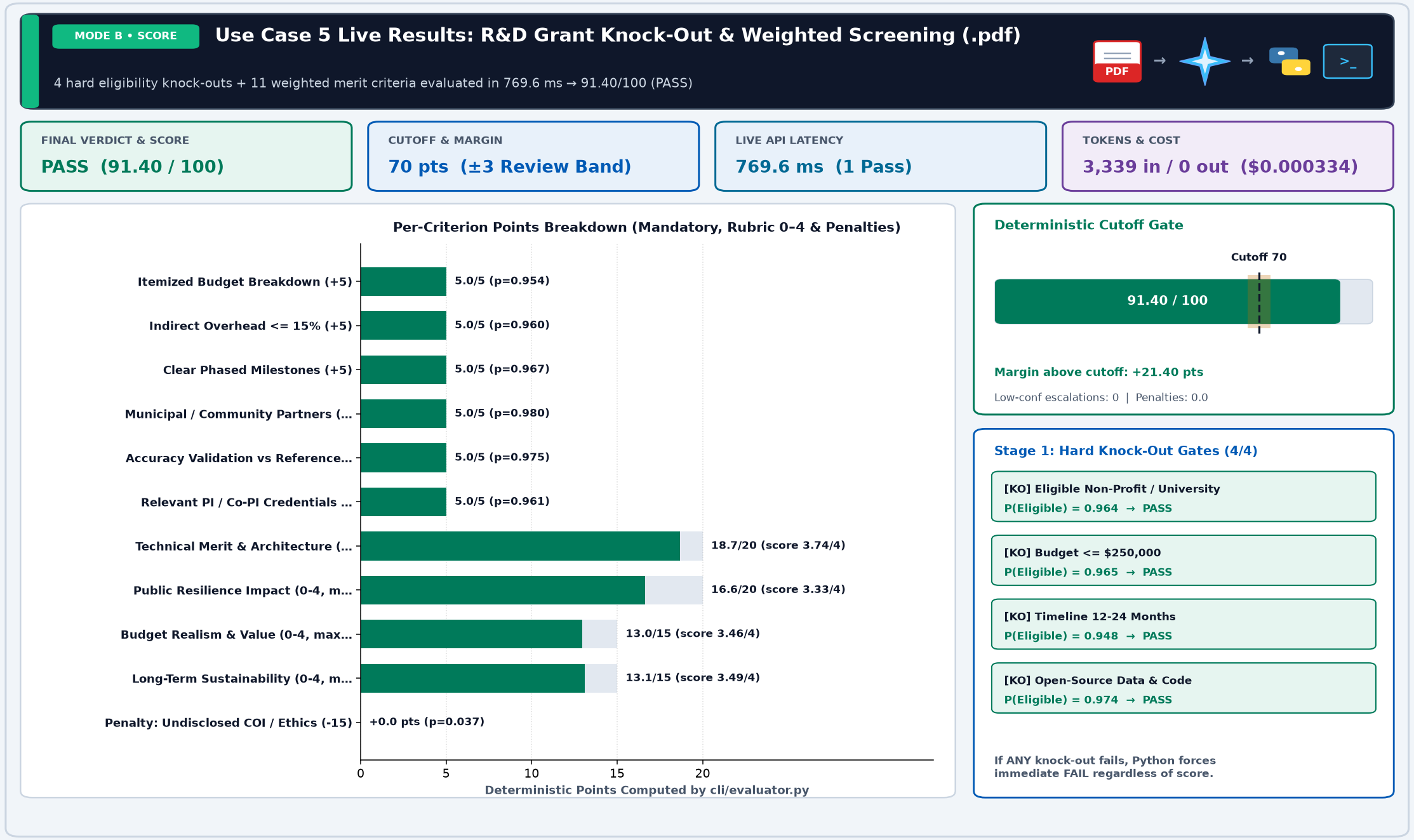 Figure 8: Live Mode B screening results for UC5 (
uc5_grant_proposal.pdf, 15 criteria, 769.6 ms, 3,339 input tokens, 0 output tokens, $0.000334), verifying 4/4 hard knock-out eligibility gates, 30.0/30.0 completeness points, 61.40/70.0 merit points, and 91.40/100.0 total score vs. the 70.0 cutoff.
Figure 8 illustrates how hard eligibility logic and nuanced merit scoring coexist deterministically in one batch:
- All 4 Hard Knock-Out Eligibility Gates Cleared (
4/4 PASS):ko_open_source_commitment(p = 0.974),ko_budget_cap<=$250,000(p = 0.965),ko_eligible_org(p = 0.964), andko_timeline_12_24m(p = 0.948) all passed well above the0.85threshold. Inevaluator.py, if any single knock-out gate had returnedFAIL, the overall verdict would have been forced toFAILimmediately regardless of the numeric score; if any knock-out had fallen below0.85confidence, it would have forcedNEEDS_REVIEW. - Completeness & Merit Point Calculation (
30.00 + 61.40 = 91.40 / 100.0 pts): All six+5.0completeness checks passed cleanly—has_local_partners(p = 0.980),has_validation_plan(p = 0.975),has_quarterly_milestones(p = 0.967),has_qualified_team(p = 0.961),overhead_under_15pct(p = 0.960), andhas_itemized_budget(p = 0.954)—earning30.00 / 30.00 pts. The four weighted merit scores contributedtechnical_merit_score(3.736 / 4→ 18.68 / 20.0 pts),public_impact_score(3.329 / 4→ 16.65 / 20.0 pts),budget_realism_score(3.459 / 4→ 12.97 / 15.0 pts), andsustainability_score(3.495 / 4→ 13.10 / 15.0 pts), summing to 91.4037 pts (+21.40pts above the70.0cutoff). - Zero Penalty & Zero Low-Confidence Escalations:
penalty_coi_or_ethics(-15.0pts) remained cleanly absent (p = 0.037, confidence0.963), and all 15 criteria cleared their confidence gates (low_confidence_items = []), allowing immediate automated advancement to finalist review.
UC5 Summary (Input → Findings): Screening an R&D grant proposal PDF against 4 hard eligibility knock-outs and 11 weighted merit criteria in 770 ms verified all 4/4 eligibility gates (p = 0.948–0.974), awarded full completeness points (30.0 / 30.0) plus strong merit scores (61.40 / 70.0) with zero ethics penalties, and deterministically approved the proposal (PASS at 91.40 / 100.0, +21.40 pts above cutoff).
5. Cross-Use-Case Empirical Benchmarks & Cost Analysis
Aggregating telemetry across all five live CLI executions (uc1_result.json through uc5_result.json) reveals how consistently the 1-Input × N-Criteria architecture performs across Markdown, multi-page PDF, and high-resolution PNG payloads. Figure 9 summarizes end-to-end API latency, shared-input token savings, and per-run cost across all five use cases.
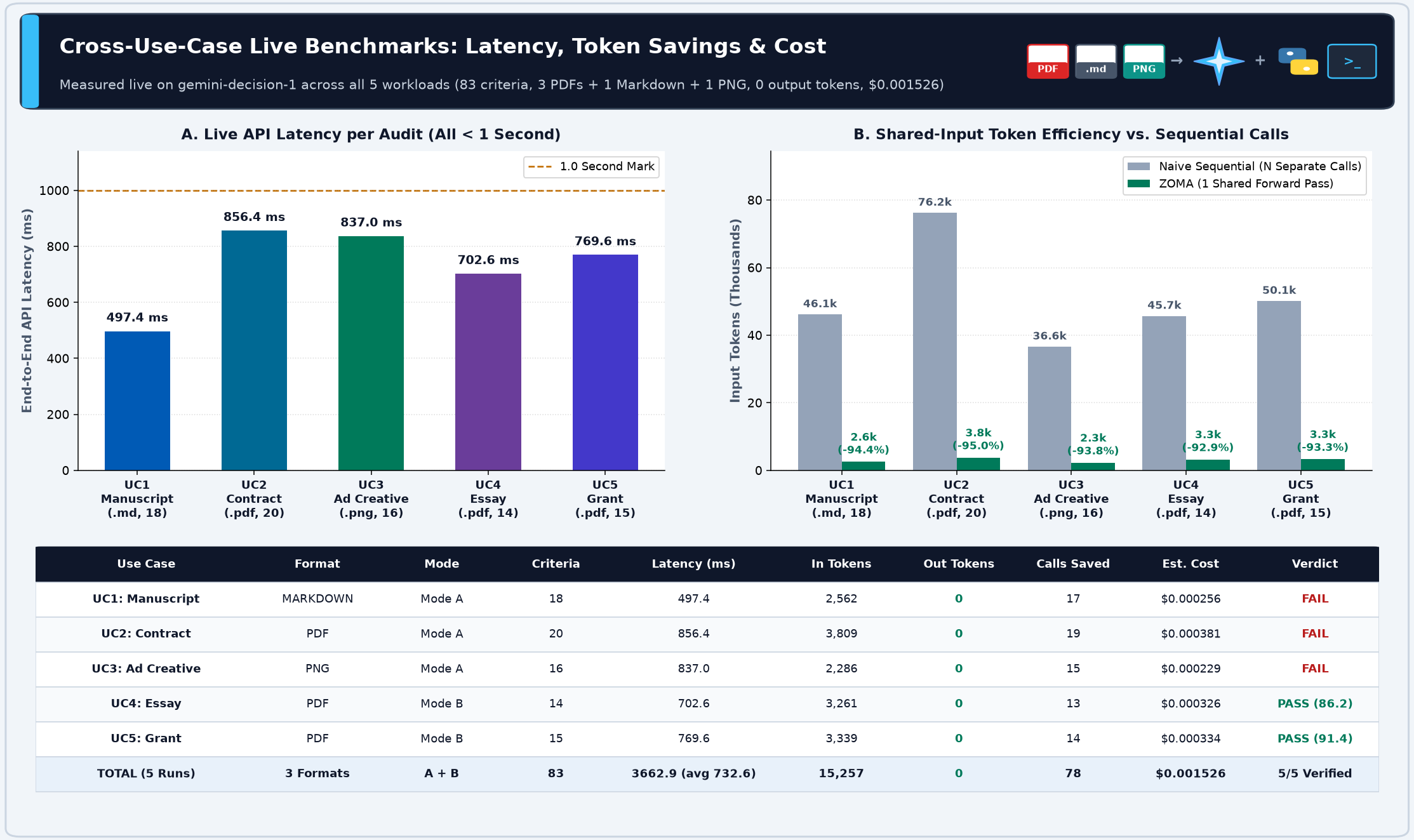 Figure 9: Live benchmark summary across UC1–UC5 showing sub-second API latency (497.4–856.4 ms, avg 732.6 ms), 92.9%–95.0% input token reduction vs. naive sequential N× calls, and $0.001526 total cost across all 83 criteria with strictly 0 output tokens.
Four empirical findings stand out from Figure 9:
- Consistent Sub-Second Latency Across All Modalities: End-to-end HTTP round-trip latency ranged from 497.37 ms (UC1, 18 criteria on Markdown) to 856.42 ms (UC2, 20 criteria on a multi-page PDF), with an overall average of 732.6 ms across all 5 runs (
UC3 = 836.97 ms,UC4 = 702.58 ms,UC5 = 769.60 ms) and 0 retries. Every run completed in a single API batch (batches = 1). - 92.9% to 95.0% Input Token Reduction vs. Sequential Calls: Sending the shared document once instead of repeating it once per criterion saved 78 sequential API calls across the 5 workflows (
83total criteria evaluated in5calls). Compared with a naive sequential baseline (N × total_input_tokens, analogous to re-sending the entire document once for every single checklist question), shared-input evaluation cut input token volume by 94.4% on UC1 (2,562vs.46,116), 95.0% on UC2 (3,809vs.76,180), 93.8% on UC3 (2,286vs.36,576), 92.9% on UC4 (3,261vs.45,654), and 93.3% on UC5 (3,339vs.50,085). - Strictly Zero Output Tokens Across All 83 Criteria: Across all five runs,
total_input_tokenssummed to 15,257 tokens, whileoutput_tokensremained strictly 0 ($0.00output cost). - Sub-Cent Total Cost (
$0.001526for All 5 Audits Combined): At$0.10per 1M input tokens Ref, individual audit costs ranged from $0.000229** (UC3) to **$0.000381 (UC2). Evaluating all 83 multimodal criteria across five full documents cost $0.001526 total—roughly 655 full multi-document audit suites per US dollar.
6. Beyond These Five Use Cases: Future Horizons for ZOMA
The five live benchmarks in this article focused on Markdown, PDF, and PNG inputs, yet gemini-decision-1 natively supports a 262,144-token unified multimodal context spanning text, JSON, PDFs, images, audio, and video Ref. Whenever an organization needs to inspect one rich artifact against dozens or hundreds of structured rules, the exact same ZOMA pattern applies without changing the architecture. Figure 10 highlights six additional high-leverage applications across industries.
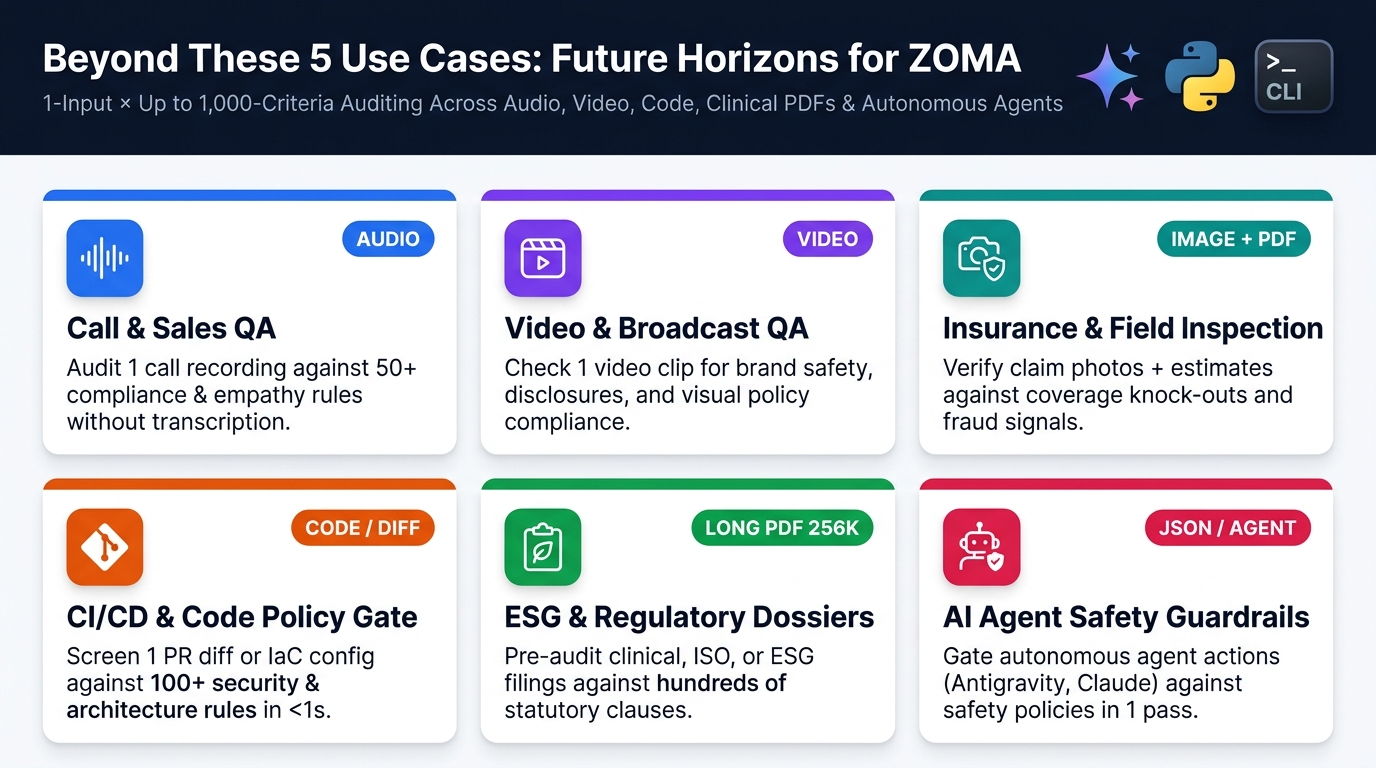 Figure 10: Six additional real-world applications of Zero-Output Multimodal Auditing (ZOMA) across audio, video, combined image+PDF packets, code diffs, long regulatory PDFs, and autonomous AI agent guardrails.
As illustrated in Figure 10, ZOMA extends naturally well beyond document and ad checks:
- Customer Support Call & Sales Recording QA (
AUDIO): Submit one recorded support or sales call natively as audio against 50+ compliance, script-adherence, empathy, and mandatory legal-disclosure rules (noul+score) in a single pass—with no separate speech-to-text transcription pipeline required. - Video Ad, Tutorial & Broadcast Compliance Screening (
VIDEO): Evaluate one short promotional clip or training video directly against brand safety, age-rating, logo visibility, caption accuracy, and regulatory claim policies before publication. - Insurance Claim & Field Inspection Verification (
IMAGE + PDF): Combine damage photos and a contractor estimate PDF into one shared input and audit it against policy coverage knock-outs, fraud indicators, and automated payout tiers using Mode B (weighted_scoring). - CI/CD Pull Request & Infrastructure Policy Gate (
CODE / DIFF): Screen one pull-request diff, Dockerfile, or Terraform plan against 100+ internal security, privacy, and architectural guidelines in under a second inside CI/CD pipelines or autonomous coding loops. - Clinical Trial, ISO & ESG Regulatory Dossier Pre-Audit (
LONG PDF 256K): Pre-check lengthy statutory filings—such as medical study protocols, ISO quality manuals, or ESG sustainability disclosures—against hundreds of regulatory clauses before paying for formal external audits. - Real-Time AI Agent Safety & Tool-Call Guardrails (
JSON / AGENT): Gate proposed actions, tool arguments, or generated deliverables from autonomous agents (such as Antigravity or Claude) against dozens of safety, PII, and policy boundaries in a single sub-second forward pass before execution.
7. Limitations, Best Practices & Summary
While Zero-Output Multimodal Auditing (ZOMA) excels at high-throughput verification and structured scoring, treating it as a drop-in replacement for every generative workflow is a mistake. Five engineering principles keep production deployments reliable:
- Pair Decisions API with a Reasoning Model When Explanations Are Required: Because
gemini-decision-1emits zero output tokens, it tells you which clauses failed (risk_uncapped_customer_indemnity: p = 0.973) and how confident it is, not how to redline the contract prose. The optimal production pattern is a two-stage cascade: rundecisions_audit.pyon 100% of incoming documents at ~$0.0003each, and invoke a generative reasoning model only on the specificFAILorNEEDS_REVIEWitems that require written redlines or student feedback. - Embed ZOMA Directly Inside AI Agents (Antigravity, Claude, and Beyond): Because the tool is a stateless Python CLI with
--format jsonoutput, agentic platforms like Antigravity and Claude can callcli/decisions_audit.pyas an external quality gate during autonomous workflows—checking their own generated manuscripts, specs, or images against dozens of organization rules in under a second for roughly$0.0003, then fixing only the flaggedFAILorNEEDS_REVIEWitems before handing the final output to a human. - Write Atomic, Observable Checklist Criteria: Compound questions (“Does the contract include SOC 2, AES-256, and 72-hour breach notice?”) blur probabilities when only two of three clauses are present. Splitting them into atomic
noulcriteria costs only a few extra question tokens per item while keeping calibrated probabilities sharp. - Tune Confidence Thresholds & Borderline Margins to Domain Risk: Defaulting to
confidence_threshold = 0.85works well for general pre-flight checks, as demonstrated by UC1 and UC2 catching ambiguous items automatically. For regulated legal or medical gates, raising the threshold to0.90–0.95widens theNEEDS_REVIEWsafety band so borderline cases always reach human reviewers. - Respect the 1,000-Question Batch Boundary: Each
POST /v1beta/decisionsrequest accepts up to 1,000 questions Ref. Ourclient.pyautomatically chunks larger checklists into sequential 1,000-question batches while preserving the shared input, though keeping single-document checklists focused and non-redundant maximizes signal clarity.
Summary
Instead of asking an AI chatbot to read a file and write long answers one question at a time, Zero-Output Multimodal Auditing (ZOMA) sends one document, PDF, or image once to Google’s Gemini Decisions API (gemini-decision-1) Ref and checks up to 1,000 rules in a single pass—with zero text generated and exact, trustworthy results:
- Under a Second and Almost Free to Run: Across all five live tests (83 checks across Markdown, PDF, and PNG files), every audit finished in under 1 second (average 732.6 ms), generated 0 output tokens, cut input tokens by 92.9%–95.0% compared to checking rules one by one, and cost $0.001526 in total—roughly 655 full five-document audits for a single US dollar.
- Catches Real Problems Without Blindly Guessing (Mode A): On technical drafts, vendor contracts, and ad images, ZOMA reliably caught confidentiality leaks, risky legal clauses, and prohibited ad promises—and whenever a rule fell in a gray area, it automatically flagged
NEEDS_REVIEWso a human could make the final call. - Exact, Math-Error-Free Grading and Screening (Mode B): On student case studies (
86.17 / 100) and grant applications (91.40 / 100), the AI evaluates each rubric item while a simple Python script handles all additions, penalties, and mandatory eligibility rules—eliminating AI calculation mistakes completely. - Ready for Both Everyday Users and AI Agents: You can immediately run the same tool on your own local files and custom checklists without building OCR or complex code, and autonomous AI agents like Antigravity and Claude can call it directly as a fast, low-cost self-check before delivering finished work.
All scripts, sample documents, checklists, and live test logs are ready to clone and run from tanaikech/gemini-decisions-api-python Ref.