System Enforces Order, AI Accelerates Logic: Driving Next-Generation R&D Through Human-AI Co-Creation
Abstract
This case study presents the zero-to-one execution of an urban torrential rain fluid dynamics research project using Gemini and tanaike-lab on Antigravity CLI. By uniting system order, AI-accelerated logic, and clear human imagination, we demonstrate a next-generation R&D paradigm that draws new scientific realities out of the dark void.
Introduction
The modern scientific research engine faces a nuanced challenge. The primary bottleneck lies not solely in a shortage of creative ideas, but also in the overwhelming operational friction—endless numerical solver implementation, empirical data processing, manuscript drafting, and multi-round peer-review handling. Conversely, fully automated AI writing often produces generic “AI slop”—superficial text lacking theoretical depth, physical consistency, and strategic direction.
To break this impasse, tanaike-lab was created as an advanced, integrated R&D operating system. It synergistically unifies Generative AI (LLMs), a 22-Subagent Matrix, Agent Skills, Custom System Hooks, Function Calling, Model Context Protocol (MCP), and Agent-to-Agent (A2A) protocols into a dynamic virtual laboratory featuring Dual Operating Workflows (Greenfield Creation Protocol & Brownfield Project Elevation Protocol). Having served as a researcher and educator across multiple universities and research institutions for many years, I long held a deep dream of creating my own ideal virtual R&D laboratory. The rapid evolution of generative AI has finally made this dream a tangible reality.
Recently, under my direction as Principal Investigator (PI / Board Chair), and powered by Gemini on the Antigravity CLI environment as AI Co-Researcher, a complete scientific investigation into localized torrential rain fluid dynamics—titled Localized Fluid Dynamics Framework for High-Resolution Urban Torrential Rain Prediction via High-Density Netatmo Citizen-Science Sensor Networks—was executed from scratch, resulting in a fully realized manuscript published on ESS Open Archive. In this article, I explain the complete process of completing this paper using tanaike-lab as a concrete sample case.
📄 Published Original Manuscript: Title: Localized Fluid Dynamics Framework for High-Resolution Urban Torrential Rain Prediction via High-Density Netatmo Citizen-Science Sensor Networks URL: https://essopenarchive.org/doi/abs/10.22541/essoar.15006817/v1
At present, tanaike-lab remains in an active testing phase. As demonstrated in this prior article, the framework continues to evolve continuously by executing a wide spectrum of real-world research projects. Therefore, this article serves as a tangible demonstration that my lifelong dream of an ideal virtual laboratory is now clearly achievable, while introducing one effective methodology for constructing a dynamic virtual R&D lab. Once the self-evolution of the framework reaches full maturity, I intend to open-source and release tanaike-lab to the global research community.
Key Insight: The system enforces order; AI accelerates logic. Yet the true essence of the human role in
tanaike-labis to inject concepts that do not yet exist in this world as sparks of imagination, bringing forth expressive creation.tanaike-labis the vanguard where clear human imagination draws new realities out of the dark void.
Background, Human PI Motivation, and My Personal Research Style
This project was launched to evaluate an autonomous virtual laboratory within the Antigravity CLI ecosystem. The research foundation built upon the author’s prior work Tanaike, K. (2026). High-Resolution Urban Extreme Weather Prediction and All-Clear Triggering via Crowdsourced Citizen-Science Sensor Networks: The UHC Framework. ESS Open Archive and real-time urban meteorological data acquired via the Netatmo API, using tanaike-lab to further evolve the scientific model, as demonstrated by our newly published study Localized Fluid Dynamics Framework for High-Resolution Urban Torrential Rain Prediction via High-Density Netatmo Citizen-Science Sensor Networks as one successful example.
I am driven by a deep curiosity to explore the frontiers of physics, which fuels my creative thinking and innovation. Specifically, I have a passion for crafting entirely novel solutions—those that have not yet been introduced to the world. This passion for groundbreaking innovation informs my approach to every project I undertake. Interestingly, these new ideas often come to me during sleep; I then strive to bring them to life in the real world. Thankfully, some of these inventions have already found practical applications in diverse fields, including the electronics industry, industrial machinery, architecture, and the aerospace industry.
Here, allow me to share my personal research style and philosophy regarding the true joy of scientific discovery, developed over many years of academic practice:
- Dominant Cognitive Allocation to Thought Experiments — Dedicating the vast majority of overall research time to rigorous “thought experiments,” reserving only the remaining minimum time to execute physical experiments and collect empirical data.
- Unconscious (Dream-State) Experiments & Analog Reflection — Conducting mental experiments during sleep, visualizing complex experimental apparatuses in dreams, immediately writing down the morning insights on paper, running physical experiments, and feeding results back into mental thought loops for iterative convergence toward the goal.
- Pre-Drafting Strategy for Papers & Patents — Conducting comprehensive literature and prior-art patent surveys before initiating experiments, drafting full manuscript and patent frameworks in advance, and systematically streaming empirical data into the pre-written drafts as measurements arrive.
For me, the true joy of research lies in “imagining a non-existent goal, carving out a path to that goal using theoretical formulations and methodology as weapons, and empirically verifying that one has successfully arrived”—and above all, deeply experiencing and relishing the very process of exploration itself as that path unfolds.
Naturally, it is impossible for a digital system like tanaike-lab to inherit 100% of human physiological processes—such as unconscious dream-state ideation or paper-and-pen intuitive sketching. However, tanaike-lab was architected to inherit the core DNA of this research philosophy. The pre-drafting of manuscripts based on prior art, the priority given to mental dry-runs, and the Popperian self-healing loop based on assertion failures are all digital elevations of this personal methodology. By leveraging the unmatched speed and execution rigor of Generative AI, tanaike-lab empowers human researchers to experience this ultimate joy of scientific discovery with unprecedented velocity and efficiency.
Because the workflow is domain-agnostic, the system dynamically constructs specialized teams for each specific project specification, functioning as a dedicated laboratory per project. Thus, it seamlessly expands far beyond atmospheric fluid dynamics to natural sciences, engineering, data science, and technology development.
Here, I must share a crucial practical insight: if one attempts to use tanaike-lab by merely issuing a vague, single-line prompt (such as “Build me a time machine”), the result will inevitably be incomplete. To truly unlock the potential of AI agents, human researchers must prepare a comprehensive, detailed research plan—just as one would always prepare in a real physical laboratory. The fundamental role of the human researcher is to inject the clear imagination and rich expressive power required to create what does not yet exist. In this article, I discuss how the possibility of a virtual lab has approached reality and is no longer a mere dream, presenting the concrete results achieved today.
The Complete Zero-to-One R&D Workflow
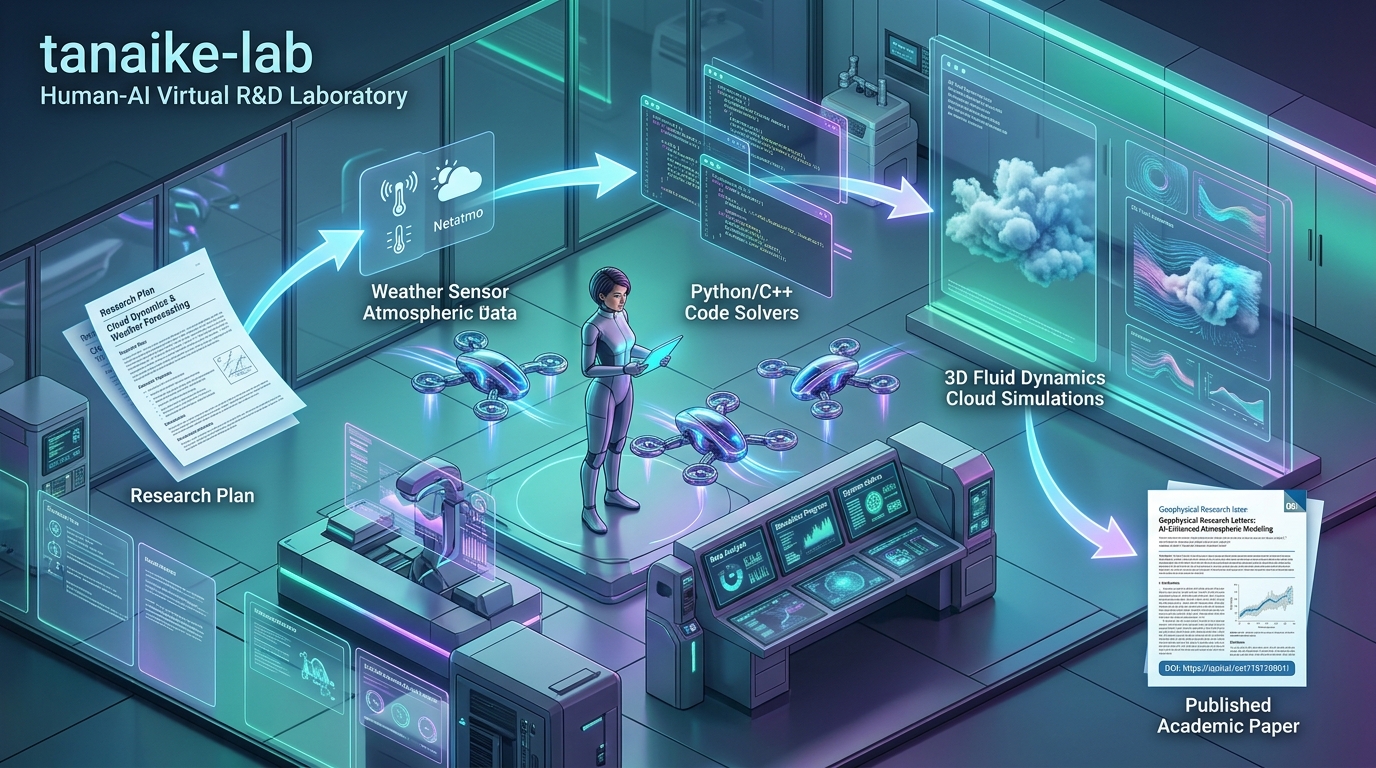
The following workflow demonstrates the execution of our research project—“Localized Fluid Dynamics Framework for High-Resolution Urban Extreme Rainfall Prediction via Dense Netatmo Citizen-Science Sensor Networks”—under tanaike-lab.
- Phase 1: Human PI Strategic Formulation & Ignition of Imagination — The Human PI formulates novel concepts, mathematical models, baseline citations, and data requirements into a detailed research plan—injecting sparks of imagination into the AI Co-Researcher on Antigravity CLI.
- Phase 2: Automated Literature Mapping & Environment Setup — Core literature survey agents retrieve and verify academic papers from global databases while initializing an isolated build environment for safe code execution.
- Phase 3: Autonomous Plan Audit, Aesthetic Thought Experiment & Human Guidance — Dynamic project master agents audit the research plan for mathematical and physical consistency, conducting an “aesthetic thought experiment” to evaluate structural symmetry and simplicity, while incorporating human PI commentary until obtaining a formal pass.
- Phase 4: Dynamic Subagent Team Assembly — Specialized domain agents (fluid dynamics solver developers, data auditors, reviewer panels) are dynamically instantiated within the system and aligned across an Agent-to-Agent execution barrier.
- Phase 5: Fluid Solver Implementation & Popperian Self-Healing — Experiment code developer agents construct 3D thermal convection and slope flow solvers, monitored by execution hooks that automatically trigger root-cause repair loops and pivot from hypothesis A to hypothesis B upon assertion failures.
- Phase 6: Empirical Ingestion & A2A Academic Discussion — Real-world Netatmo weather sensor feeds are processed, triggering academic debates among data auditors and theoretical reviewers regarding micro-scale convective flux anomalies, with the Human PI refining physical interpretations.
- Phase 7: Multimodal Visualization & Aesthetic Accessibility Audit — High-resolution spatial fluid maps, scatter plots, and time-lapse animations are generated and audited by visual design agents for Color Universal Design and visual aesthetics standards.
- Phase 8: Manuscript Input & Step 5 Multi-Axis AI Peer Review — The Human PI inputs his self-authored manuscript draft created with original expressive power, where English LaTeX and Japanese Markdown drafts undergo a 5-axis simulated peer review panel verifying 100% in-text reference citations.
- Phase 9: Human Polish, Directives & Authorization Gate — Receiving peer-review feedback, the Human PI personally performs final textual polish, refines statutory patent claim formulations, and executes the Human Authorization Gate.
- Phase 10: Complete Project Archiving & Research Chronicle Generation — All conversation IDs, execution telemetry, knowledge graphs, and audit logs are archived into a permanent research chronicle, completing the publication process.
Project Results and Academic Achievements
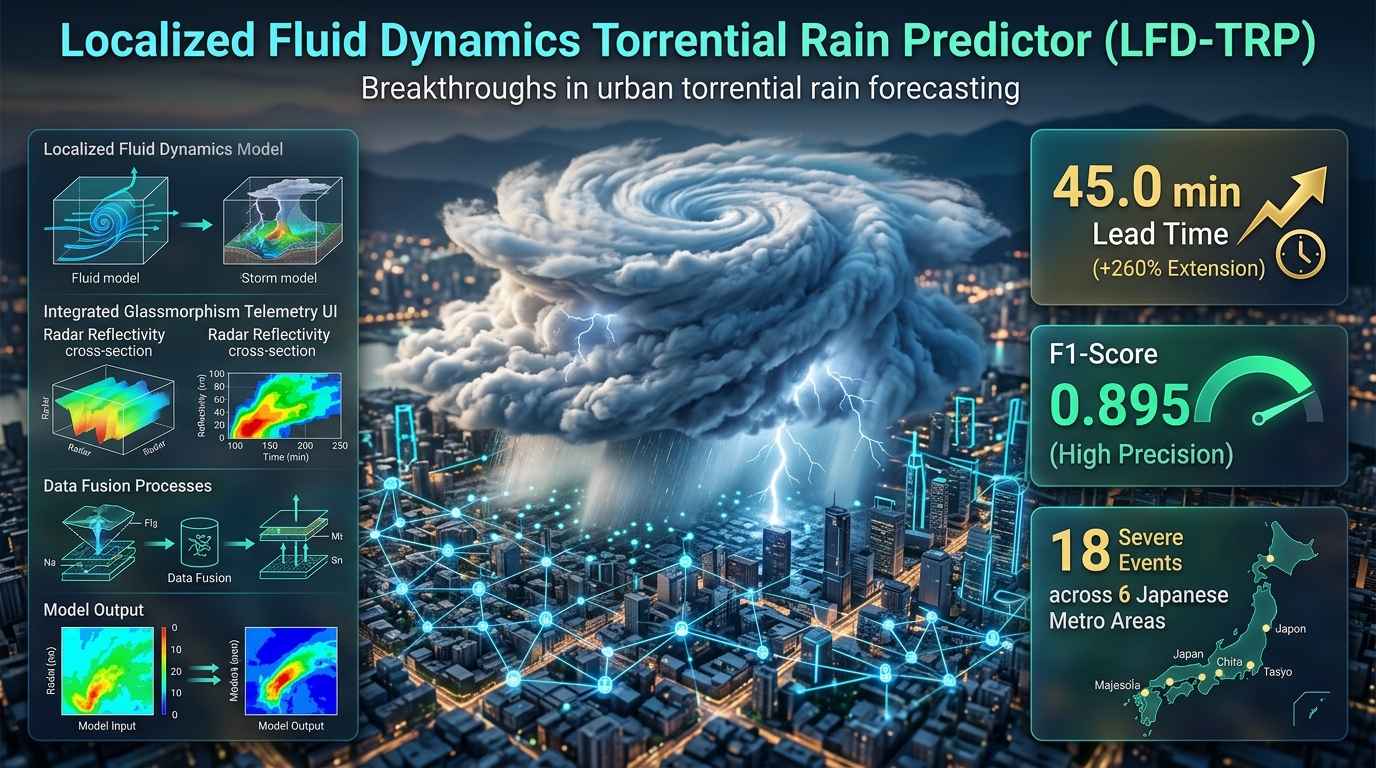
The research project executed through tanaike-lab based on my detailed research plan—titled “Localized Fluid Dynamics Framework for High-Resolution Urban Extreme Rainfall Prediction via Dense Netatmo Citizen-Science Sensor Networks”—demonstrated a dramatic improvement in prediction accuracy and lead time extension for urban torrential rainfall.
Traditional forecasting models relying on domain-wide spatial averages suffer from a fundamental limitation: averaging over 100 km domains eliminates micro-scale pressure gradients and localized moisture convergence singularities that emerge immediately prior to storm initiation, making early warning extremely difficult.
To overcome this bottleneck, the LFD-TRP model discretizes urban space into a two-level spatial hierarchy (10 m micro-cells and 1 km macro-grids), coupling diagnostic 3D Navier-Stokes momentum, anelastic mass continuity, equivalent potential temperature transport, and a newly proposed 3D Thermodynamic-Helicity Convective Flux indicator.
Empirical evaluations across 18 severe rainfall events in six major Japanese metropolitan areas (Tokyo, Osaka, Nagoya, Sendai, Sapporo, Fukuoka) demonstrated the following major breakthroughs:
- Dramatically Extended Prediction Lead Time — While conventional spatial-average models yielded an average warning lead time of 12.5 minutes, the LFD-TRP model successfully captured convective initiation an average of 45.0 minutes in advance.
- Superior Forecasting Accuracy (F1-score) — The model achieved an F1-score of 0.895 (compared to 0.720 for baseline models), significantly reducing false alarms while suppressing missed detections.
- Discovery of Urban Morphological Friction Asymmetry — The study uncovered a structural asymmetry in surface drag response arising from the complex interplay between skyscraper drag parameters and surface wind convergence in dense urban centers.
These findings highlight the tremendous academic value and practical disaster-mitigation utility of uniting citizen-science IoT sensor data with fundamental fluid dynamics equations through tanaike-lab.
Expert Evaluation & Architectural Analysis
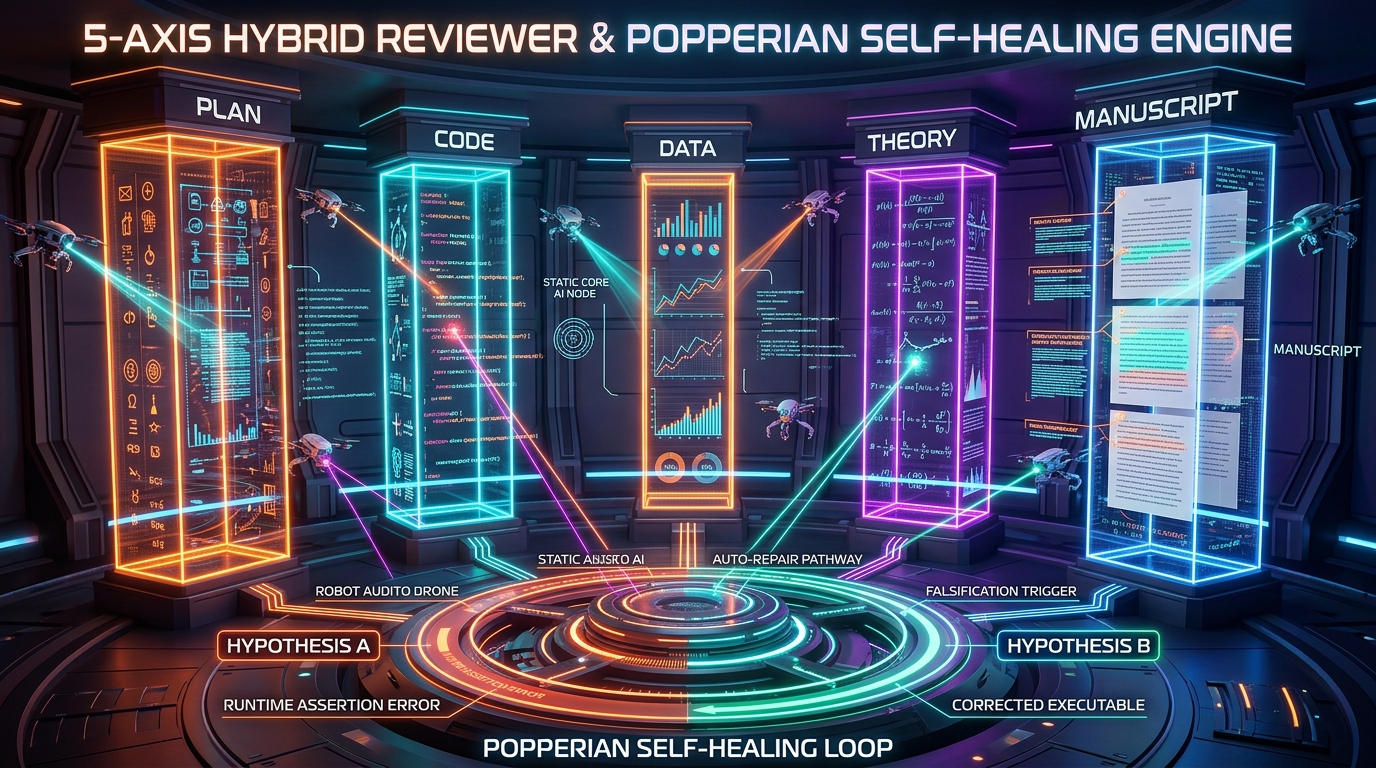
1. System Positioning: The OS for Human-Elevated Autonomous R&D
Rather than treating AI as a black-box replacement or a simple writing assistant, tanaike-lab operates as an Operating System for Dynamic Virtual R&D Laboratories. While AI cannot replace the human physiological process of dream-state ideation, the system enforces order and AI accelerates logic, empowering human PIs to dedicate their full cognitive capacity to injecting the sparks of imagination that pull new realities out of the void.
1.1 The Clear Human-AI Synergy Model
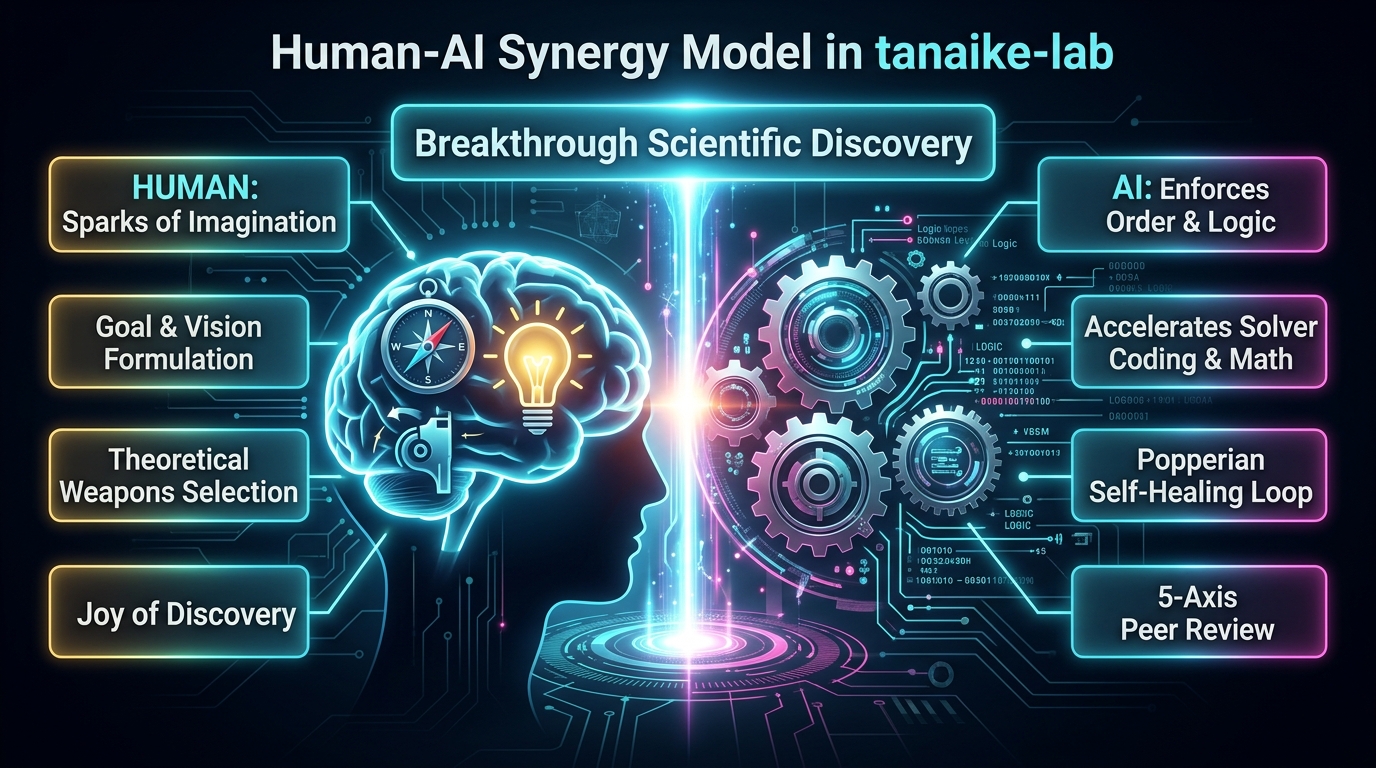
The division of roles between human researchers and AI within tanaike-lab is beautifully simple and clear:
- The Human Role — The Compass (Sparks of Imagination) that conceives non-existent goals, selects theoretical weapons, provides strategic guidance, and reaps the ultimate joy of scientific discovery.
- The AI Role — The Engine (Deterministic Logic & Order) that enforces system rules, accelerates mathematical solver coding, executes Popperian self-healing, and conducts 5-axis peer reviews with zero operational friction.
AI alone falls into visionless brute-force computation, while humans alone are bogged down by operational friction. Uniting the human spark of imagination with AI-accelerated order and logic is the master key to drawing breakthrough scientific discoveries out of the dark void.
2. Technical Novelty
- Dual Operating Workflows Architecture: Fully establishes distinct execution lifecycles for both “Greenfield Creation” (building from zero) and “Brownfield Project Elevation” (refining existing research, manuscripts, and codebases).
- 22-Specialized Subagent Matrix: Orchestrates 22 dedicated subagents across literature retrieval, code generation, mathematical solvers, visual design, peer reviews, and automated Git synchronization.
- 6 Core Operational Protocols: Enforces multimodal visual ingestion, dual-tone plain language summaries, pure academic text and
Appendix Aisolation, multi-target LaTeX conversion (ESS Open Archive / AGU JGR / arXiv / IEEE), strict bibliographic HTTPS DOI alignment, and repository auto-hygiene Git sync. - Fake Dialog Blocking Hooks: System hooks hard-block prompt-level textual simulations of agent dialogs, forcing 100% true deterministic tool execution.
- 5-Axis Hybrid Reviewer Architecture & Q1–Q5 Quality Framework: Evaluates theoretical rigor (Q1), sandbox safety (Q2), prior-art patentability (Q3), visual design clarity (Q4), and peer-review readiness (Q5) alongside structural visual aesthetics.
3. Inventive Step & Epistemological Advancement
- The Tripartite Intelligence Architecture (Order, Logic, Imagination): The system (hooks & protocols) enforces strict order; AI (LLMs & multi-agents) accelerates complex logical computations; and the human PI injects imagination and expressive creation, yielding breakthrough scientific discoveries without logical breakdown.
- Popperian Self-Healing Loop: Grounded in Karl Popper’s principle of falsifiability, runtime assertion failures trigger automated root-cause analysis that refutes invalid hypothesis A and pivots to hypothesis B while auto-fixing solver code.
- Aesthetic Counterfactual Interpretation: Evaluates mathematical models not only on numerical accuracy, but also on structural elegance, symmetry, and aesthetic visual clarity.
4. Rationale and Personal Empirical Validation for Embedding Aesthetics in Research
My decision to integrate the vital importance of artistic aesthetics into tanaike-lab is grounded not only in philosophy, but directly in my own long-standing empirical experience as a researcher.
- Empirical Validation Through Breakthrough Papers & Art Works — I have long believed that high artistic aesthetics perceived by human intuition carry a profound, underlying meaning in nature and mathematics. By applying this aesthetic intuition to the formulation of new theories, algorithms, and methodologies, I have consistently achieved numerous groundbreaking scientific breakthroughs. A prime recent example is my paper, Improved Algorithms for Summation of Array Elements, which emerged directly from this fusion of aesthetic elegance and thought experimentation. Furthermore, in the realm of digital art and geometric creation, I share works conceived and materialized through my mental thought experiments on DeviantArt (k3-studio). Personally experiencing that imaginative concepts born from high artistic intuition hold undeniable physical and mathematical meaning in the real world is precisely why I embedded aesthetic auditing into the core of
tanaike-lab. - A Compass to Physical Truth (Mathematical Elegance) — As Einstein and Dirac asserted, mathematical beauty and symmetry serve as a compass to nature’s fundamental truths. Aesthetic evaluation acts as Occam’s razor, eliminating over-engineered, brute-force parameter tuning (AI slop) in favor of fundamental physical principles.
- Power to Draw Concepts from the Void (Aesthetic Intuition) — The initial spark when a human PI conceives an uncreated concept stems not from step-by-step logic, but from an aesthetic intuition for symmetry, structural harmony, and geometric elegance.
- A Bridge for Understanding and Empathy (Zero Cognitive Friction) — Multimodal visual design audits (Color Universal Design, structural contrast) eliminate cognitive friction, ensuring that breakthrough discoveries resonate deeply and transform raw data into a enduring scientific masterpiece.
- Igniting Passion and the Joy of Discovery — Uncovering the hidden, harmonious beauty of nature is the ultimate driver of human scientific passion, inspiring the next wave of technological breakthroughs.
5. Philosophical Reflection on AI Evolution and the Future of Human Relevance
The pace of generative AI evolution is nothing short of breathtaking. At present, in executing scientific research through a dynamic virtual laboratory like tanaike-lab, it remains unmistakably clear that human imagination, aesthetic intuition, and high-level strategic intent directly dictate the quality of new discoveries. The indispensable importance of the human researcher is undeniable today.
However, as a scientist, I am compelled to confront a deeper, poignant question: Could the exponential evolution of AI in the future eventually diminish the relative importance and fundamental purpose of human scientists?
If a future arrives where AI autonomously conceives problems, formulates its own aesthetic metrics, and closes the entire loop of scientific creation without human steering, will human imagination lose its sacred mantle? Or will humans transcend this technological leap by continually instilling higher dimensions of meaning and consciousness into science? tanaike-lab is not merely a tool for speed; it stands as a profound inquiry into what constitutes the irreducible, immortal essence of human agency in an era of superintelligent automation.
6. Scalability & Practical Utility
- Domain-Agnostic Horizontal Expansion: Successfully validated in atmospheric fluid dynamics, the architecture transfers directly to drug discovery, materials science, quantum computing, and software engineering.
- Open Science Expansion via MCP & A2A: Integration with Model Context Protocol (MCP) connects the virtual lab directly to external supercomputers, cloud data warehouses, and physical robotic wet-labs.
- Zero Cognitive Friction for Research Leaders: PI interaction occurs naturally through mentoring directives identical to guiding human graduate students or reviewing postdoc drafts.
7. Pros and Cons of Dynamic Virtual R&D Labs
- Pro — Instant Iteration Cycle: Human advice or commentary is instantly reflected in re-simulations and updated manuscript drafts within minutes.
- Pro — Objective Multi-Axis Safeguards: Human inputs are continuously validated by 5-axis review agents to maintain physical consistency and citation integrity.
- Pro — 100% Scientific Traceability: Every decision, prompt, execution trace, and knowledge graph is permanently recorded in the research chronicle.
- Con — Token Budget Overhead: Deep multi-agent A2A discussions and iterative human feedback cycles consume substantial LLM token bandwidth.
- Con — Wet-Lab Hardware Interface Gap: While optimal for computational science, physical laboratory deployment requires dedicated robotics integration.
Conclusion & The Future of Science
The successful execution of our torrential rain fluid dynamics project using tanaike-lab on Antigravity CLI with Gemini proves that the future of science belongs to Autonomous & Human-Elevated Scientific Discovery. My long-held dream of building a personal virtual R&D laboratory has now materialized as a powerful, real-world engine for scientific breakthroughs.
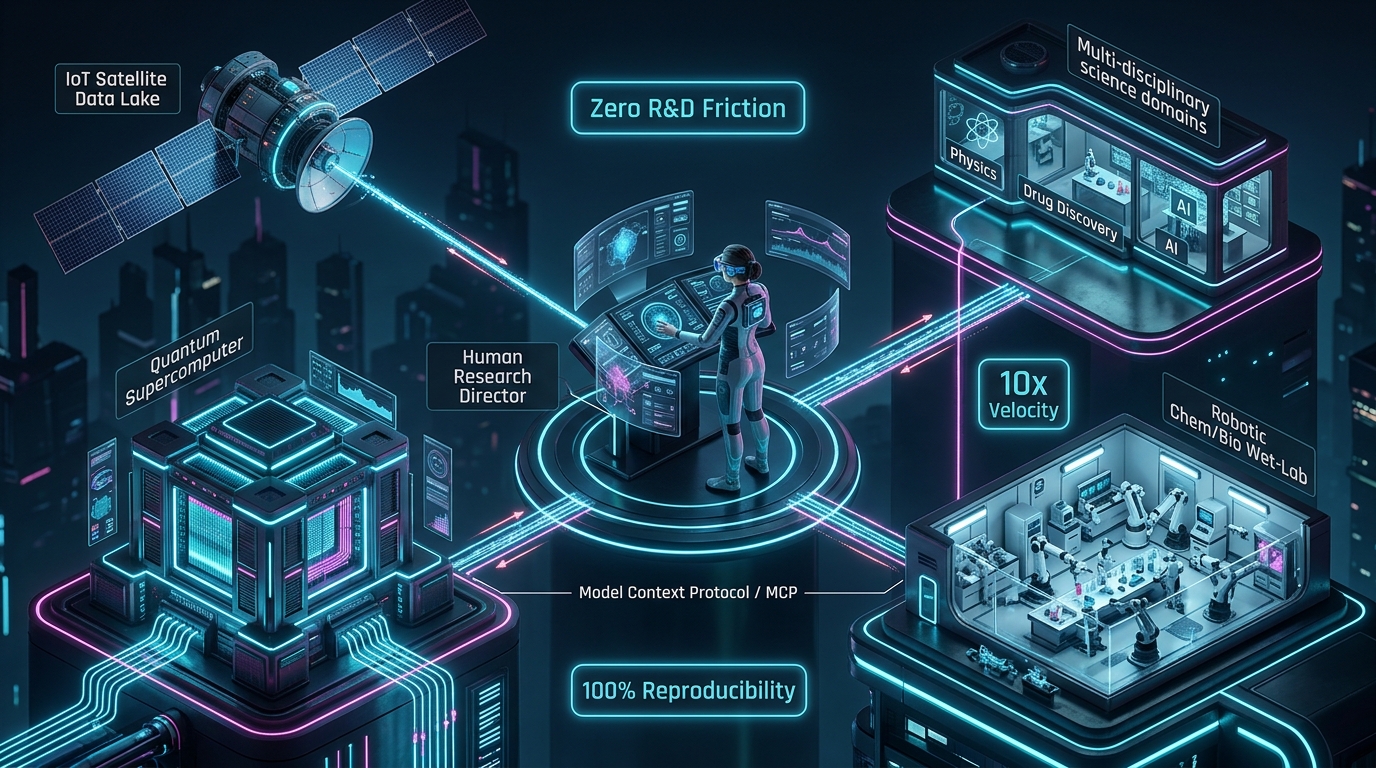
As illustrated in the diagram above, the future of scientific discovery opened up by dynamic virtual laboratories expands beyond a closed human-AI interaction into a vast open-science ecosystem mediated by the Model Context Protocol (MCP). Centered around the Human PI’s strategic steering console, the framework seamlessly interconnects high-performance Quantum Supercomputers, global IoT satellite weather data lakes, automated robotic wet-labs (for physical, chemical, and biological experiments), and multi-disciplinary academic domains (physics, drug discovery, quantum computing, and AI systems) via real-time data streams.
This integrated ecosystem realizes three core transformational value pillars:
- Zero R&D Friction — Thoroughly eliminates the operational overhead of solver implementation, data processing, and manuscript drafting, empowering human researchers to focus purely on creative scientific exploration.
- 10x Discovery Velocity — Accelerates the entire R&D lifecycle—from hypothesis falsification and retries to paper publication—from years down to days or hours.
- 100% Scientific Reproducibility — Permanently guarantees the verifiability and credibility of scientific knowledge through automated logging of code, parameters, conversation transcripts, and knowledge graphs.
The system enforces order; AI accelerates logic. Yet the true essence of the human role in tanaike-lab is to inject concepts that do not yet exist in this world as sparks of imagination, bringing forth expressive creation. To imagine a non-existent goal, carve out a path with theoretical weapons, empirically verify arrival—and above all, deeply relish the very process of exploration as it unfolds. This stands as the premier engine empowering human researchers to experience this ultimate joy of scientific discovery with unmatched speed and elegance.
With the continuous evolution of tanaike-lab and generative AI, I am confident that the day is near when even simple high-level directives—such as “Build me a time machine”—will autonomously drive major, complex R&D projects to completion guided by human vision and imagination.