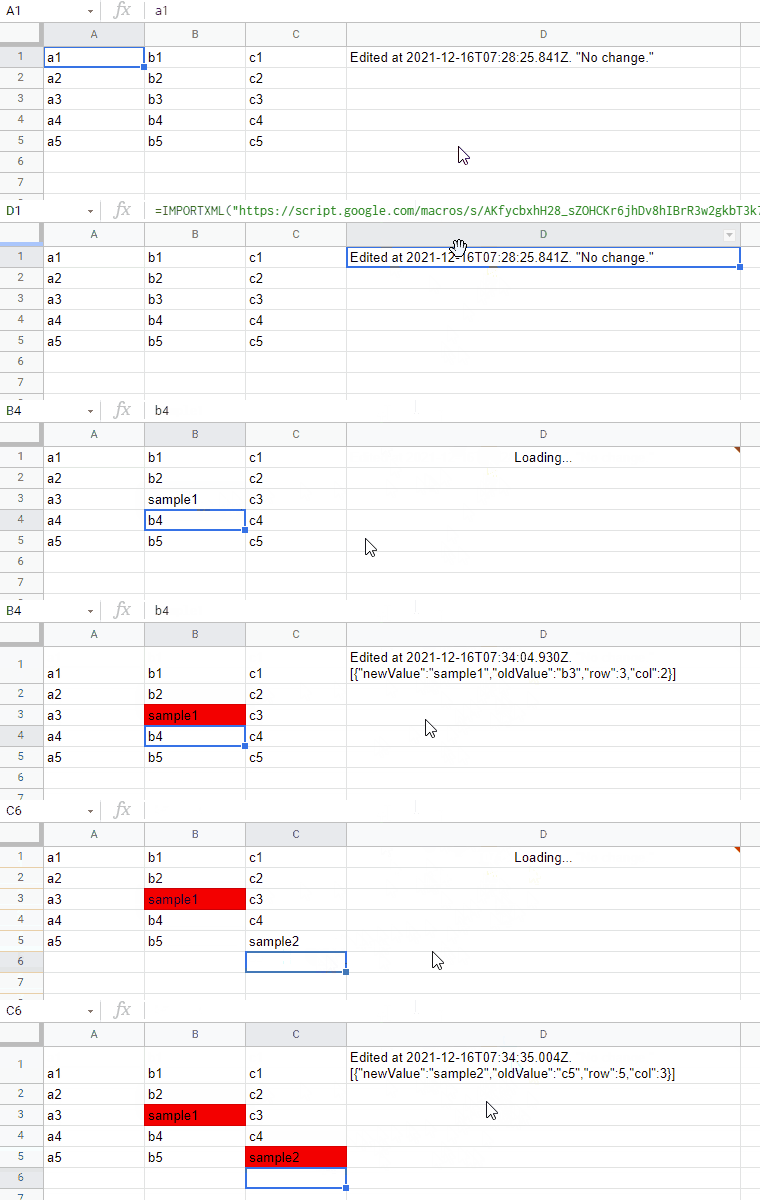
Retrieving Glyph Value from List Items of Google Document using Google Apps Script

Gists

This is a sample script for retrieving the glyph value from the list items of Google Document using Google Apps Script.

In the current stage, when the list is put to the Google Document, the count of glyph is automatically calculated. When the glyph values of the list items are tried to be retrieved using the manual operation and the script, unfortunately, the glyph values cannot be retrieved. Only the values of the list are retrieved. Unfortunately, it seems that in the current stage, there are no methods for directly retrieving the glyph value from the list items.

Report: Images put with IMAGE function on Google Spreadsheet

Gists

This is a report about images put with “=IMAGE(IMAGE_URL)” function on Google Spreadsheet.

Experiment

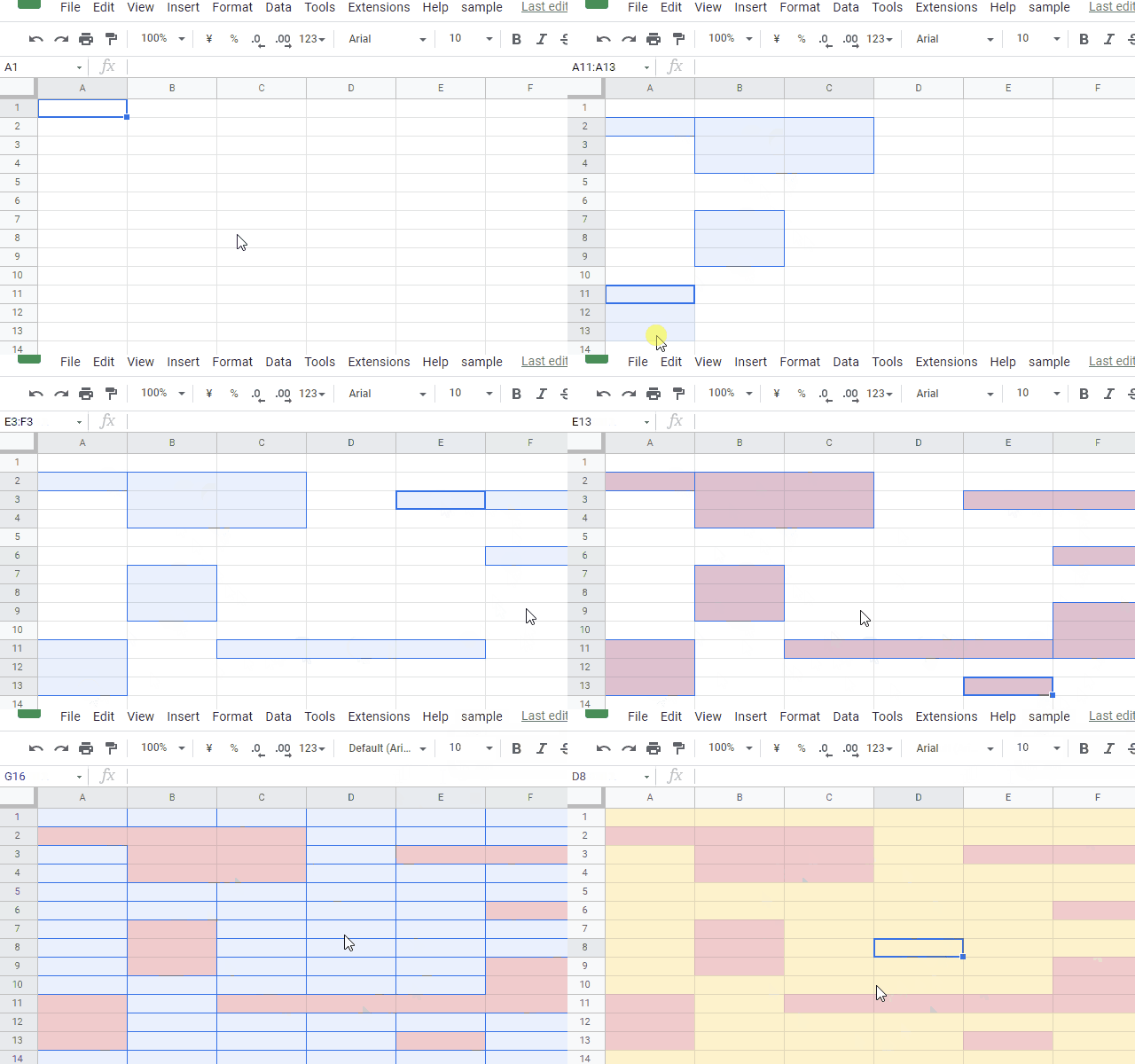
When “=IMAGE(IMAGE_URL)” is put to a cell “A1” on Spreadsheet, the image is shown in the cell as shown in the following image.

Report: Images put with IMAGE function on Google Spreadsheet

For this situation, when the following script is run,

const sheet = SpreadsheetApp.getActiveSpreadsheet().getSheetByName("Sheet1");
const range = sheet.getRange("A1");
range.copyTo(range, { contentsOnly: true });

The following result is obtained. In this case, the formula is removed and an image can be seen as shown in the following image.

File Picker using Google Apps Script and Javascript without 3rd party

GitHub

File Picker using Google Apps Script and Javascript without 3rd party

This is a sample script for the file picker using Google Apps Script and Javascript without 3rd party. I had created the same sample script before. Ref But, in the case of that script, jQuery is used. And, only Google Drive of own account could be used. In this sample script, 3rd party of jQuery is not used, and also, not only Google Drive of your own account, but also Google Drive of the service account can be used. By this, I thought that this file picker will be useful for various scenes.

Converting Values of Google Spreadsheet to Object using Google Apps Script

Gists

Converting Values of Google Spreadsheet to Object using Google Apps Script

This is a sample script for converting the values of Google Spreadsheet to an object using Google Apps Script.

Sample script

function myFunction() {
  const sheetName = "Sheet1";
  const [headers, ...rows] = SpreadsheetApp.getActiveSpreadsheet().getSheetByName(sheetName).getDataRange().getValues();
  const res = rows.map((r) => headers.reduce((o, h, j) => Object.assign(o, { [h]: r[j] }), {}));
  console.log(res);
}
  • When this script is run, the above sample image can be retrieved.

  • In this sample script, the 1st row of the sheet is used as the header row.

Updated: GAS Library - RichTextApp

RichTextApp was updated to v1.3.0

  • v1.3.0 (October 20, 2021)

    1. Added a new method of RangeToHTMLTableForSpreadsheet. In this method, the range on Google Spreadsheet is converted to a HTML table. Using this method, for example, you can send the specific range in the Spreadsheet as an email by including a HTML table.

Updated: GAS Library - RichTextApp

You can see the detail information here https://github.com/tanaikech/RichTextApp

Taking Advantage of TextFinder for Google Spreadsheet

Gists

There is Class TextFinder in Spreadsheet service for Google Apps Script. Ref The TextFinder can search and replace the texts in the Spreadsheet using Google Apps Script. There is the method for createTextFinder in Class Spreadsheet, Class Sheet and Class Range. When these methods are used, you can search and replace the texts for all sheets in a Spreadsheet, the specific sheet, and the specific range in the specific sheet.

Sending Multiple Emails using Batch Request with Gmail API using Google Apps Script

Gists

Sending Multiple Emails using Batch Request with Gmail API using Google Apps Script

This is a sample script for sending multiple emails using the batch request with Gmail API using Google Apps Script. When multiple emails are sent using “GmailApp.sendEmail” and “MailApp.sendEmail”, a loop is used. But in this case, the process cost becomes high. In this post, I would like to introduce the sample script for reducing the process cost under this situation. Gmail API can be requested with the batch request. The batch request can be processed with the asynchronous process. By this, I thought that the process cost for sending multiple emails. So, this sample script sends multiple emails using the batch request with Gmail API.

Putting All Response Values from Google Form to Google Spreadsheet using Google Apps Script

Gists

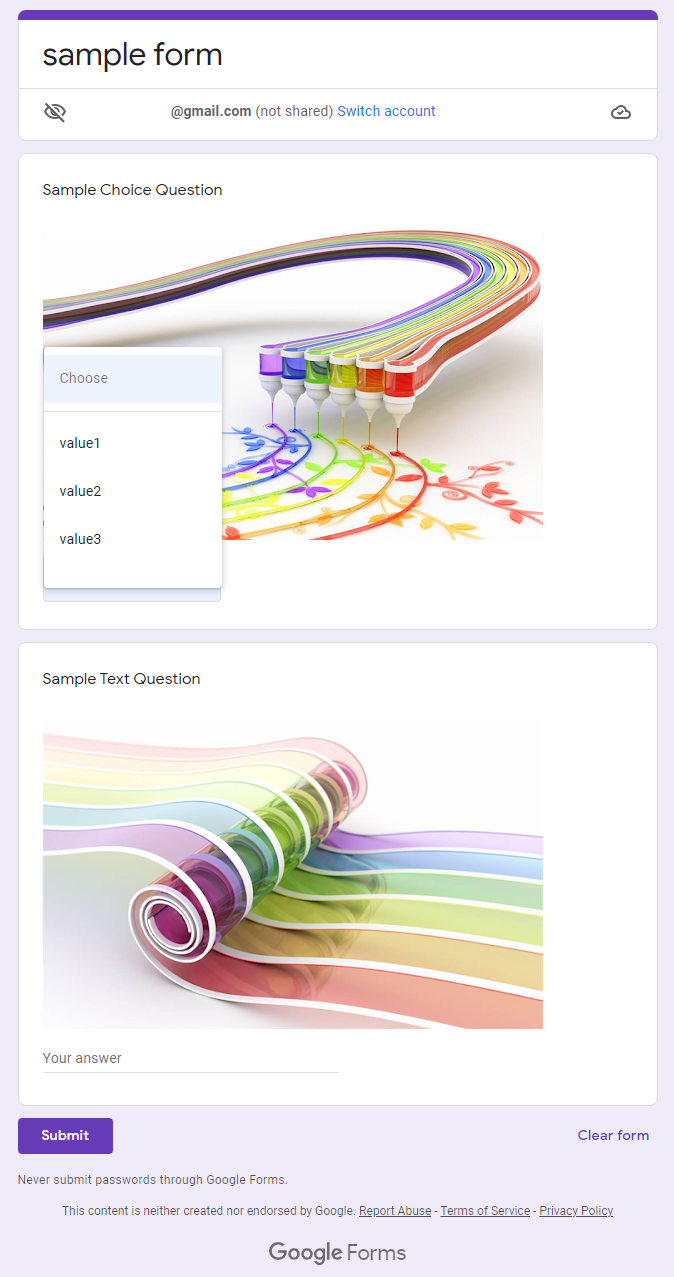
This is a sample script for putting all response values from Google Form to Google Spreadsheet using Google Apps Script.

Putting All Response Values from Google Form to Google Spreadsheet using Google Apps Script

Sample script

Please copy and paste the following script to the script editor of Google Spreadsheet and set the variables of formId and sheetName.

function myFunction() {
  const formId = "###"; // Please set the Google Form ID.
  const sheetName = "Sheet1"; // Please set the sheet name of sheet you want to put the values.

  // Retrieve all response values from Google Form.
  const form = FormApp.openById(formId);
  const headers = ["date", ...form.getItems().map(e => e.getTitle())];
  const values = [headers, ...form.getResponses().map((f) => {
    const timeStamp = f.getTimestamp();
    return f.getItemResponses().reduce((o, i) => {
      const r = i.getResponse();
      return Object.assign(o, {
        [i.getItem().getTitle()]: Array.isArray(r) ? r.join(",") : r,
      });
    }, { date: timeStamp });
  }).map((o) => headers.map((t) => o[t] || ""))];

  // Put the values to Spreadsheet.
  SpreadsheetApp.getActiveSpreadsheet().getSheetByName(sheetName).getRange(1, 1, values.length, values[0].length).setValues(values);
}
  • When this script is run, all response values are retrieved from Google Form and put them to the Spreadsheet.

Note

  • At Google Form, when the empty answer is submitted, the question has no value. By this, it is required to consider this. So at first, the titles are retrieved from the items, and the values are created using the item titles. I thought that this might be an important point.

References

Google OAuth Verification & Application Privacy Policy

Registered Application Name: Workspace & Gemini AI Orchestration Engine

Application Purpose & Core Functionality:

This web page serves as the official homepage and privacy compliance interface for the application "Workspace & Gemini AI Orchestration Engine". This specialized developer utility is designed to research, benchmark, and optimize advanced integrations between Google Workspace services, the Google Apps Script API, and Gemini AI models (via Google Vertex AI / Gemini API endpoints).

The application facilitates automated multi-agent scaffolding, programmatic script deployment, project resource management, and structural analysis of Google Apps Script projects. It allows developers and autonomous AI agents (operating via Model Context Protocol / MCP) to securely evaluate execution performance, implement high-performance batch requests, and test agent-to-agent (A2A) workflows within a controlled and structured environment.

Google User Data Policy Compliance Statements:

1. Data Access & Specific Usage

Our application explicitly requests access to specific Google user accounts through OAuth scopes required strictly for interacting with the Google Apps Script API and Google Workspace endpoints. This access is utilized solely to execute user-initiated or agent-orchestrated programmatic operations—such as creating, modifying, deploying, or benchmarking script projects and executing automated workflows. No background automated extraction occurs without explicit session initiation.

2. Data Storage & Zero-Retention Policy

Adhering to a strict Zero-Retention Model, this application does not store, log, or persist any personal data, OAuth tokens, script source codes, or Google account configurations on any external server, database, or persistent storage medium. All data processing and API responses are handled entirely in-memory or securely on the client side within the active session context, ensuring complete cryptographic transient isolation.

3. Data Sharing & Third-Party Non-Disclosure

We maintain absolute data privacy. No data accessed via Google OAuth scopes is shared, sold, rented, or transferred to third-party entities, advertising networks, or data brokers. All data transmissions are strictly point-to-point, encrypted in transit using industry-standard protocols, and limited entirely to the direct channel between the execution environment and Google's official API gateways.

For inquiries regarding this developer application, technical benchmarks, or verification compliance, please refer to the official documentation and repositories linked on this homepage (tanaikech.github.io).