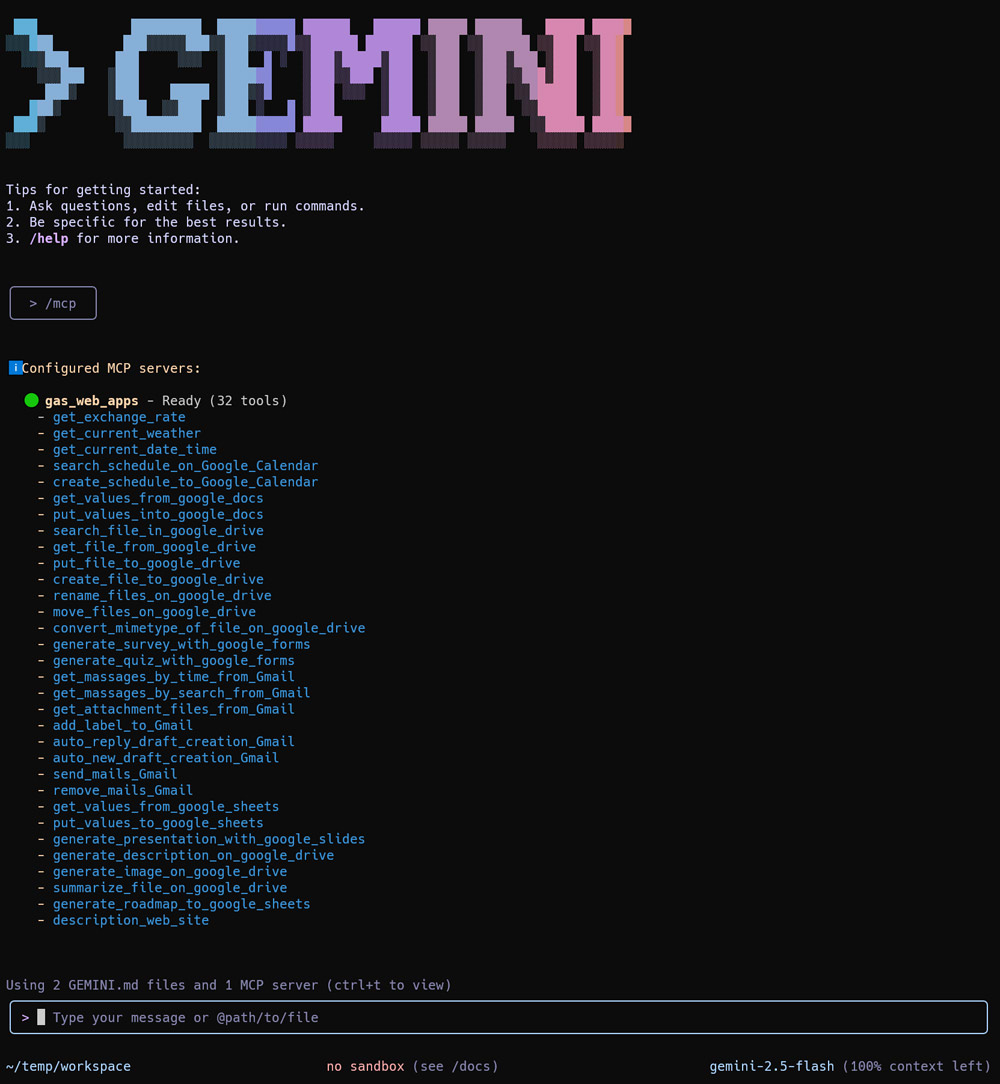
Updated: GAS Library - ToolsForMCPServer

ToolsForMCPServer was updated to v1.0.10

  • v1.0.10 (July 26, 2025)

    1. When I updated Gemini CLI from v0.1.12 to v0.1.13, an issue related to the schema of MCP occurred. Ref So, as a workaround at the time, I updated this library. But when I updated Gemini CLI to v0.1.14, I confirmed that the previous schema could be used. So, I reimplemented the previous schema. By this, the request body for APIs can be directly generated using Gemini CLI v0.1.14.

You can see the detailed information here https://github.com/tanaikech/ToolsForMCPServer

Updated: GAS Library - ToolsForMCPServer

ToolsForMCPServer was updated to v1.0.8

  • v1.0.8 (July 23, 2025)

    1. An issue occurred when I updated Gemini CLI from v0.1.12 to v0.1.13. Ref Fortunately, Google is already aware of this issue, and I’m awaiting a resolution. In the meantime, I’ve received emails about it, so I’ve updated ToolsForMCPServer for Gemini CLI v0.1.13. The detailed updates are as follows: I confirmed that all tools in ToolsForMCPServer v1.0.8 worked when tested with Gemini CLI v0.1.13.
    • oneOf has been removed from the schema of each tool.
    • Following this report, the request body is now generated on the MCP server side. Therefore, when using the tools manage_google_docs_using_docs_api, manage_google_sheets_using_sheets_api, and manage_google_slides_using_slides_api, please use your API key for the Gemini API.

You can see the detailed information here https://github.com/tanaikech/ToolsForMCPServer

Generating Request Body for APIs using Gemini

Gists

Generating Request Body for APIs using Gemini

Abstract

Effortlessly generate API request bodies from natural language commands. This guide demonstrates using Gemini and Google Apps Script to streamline automation and accelerate development for Google Workspace APIs and beyond.

Introduction

In a recent article, “Managing Google Docs, Sheets, and Slides by Natural Language with Gemini CLI and MCP,” I showcased a powerful method for dynamically creating API request bodies using natural language. This approach, utilizing the Gemini CLI and a My Custom Proxy (MCP) server, allows users to manage Google Workspace applications with simple, human-readable commands. The core concept is that generating API request bodies directly from natural language within a script can dramatically streamline automation and development.

Updated: GAS Library - ToolsForMCPServer

ToolsForMCPServer was updated to v1.0.7

  • v1.0.7 (July 19, 2025)

    1. Added a getToolList method for retrieving all current tools in the library.
    2. Tools can be filtered using enables or disables as an array argument for the getTools method. If enables is used, only the tools specified in the enables array will be used. If disables is used, all tools except those specified in the disables array will be used. If neither enables nor disables is used, all tools will be used.

You can see the detailed information here https://github.com/tanaikech/ToolsForMCPServer
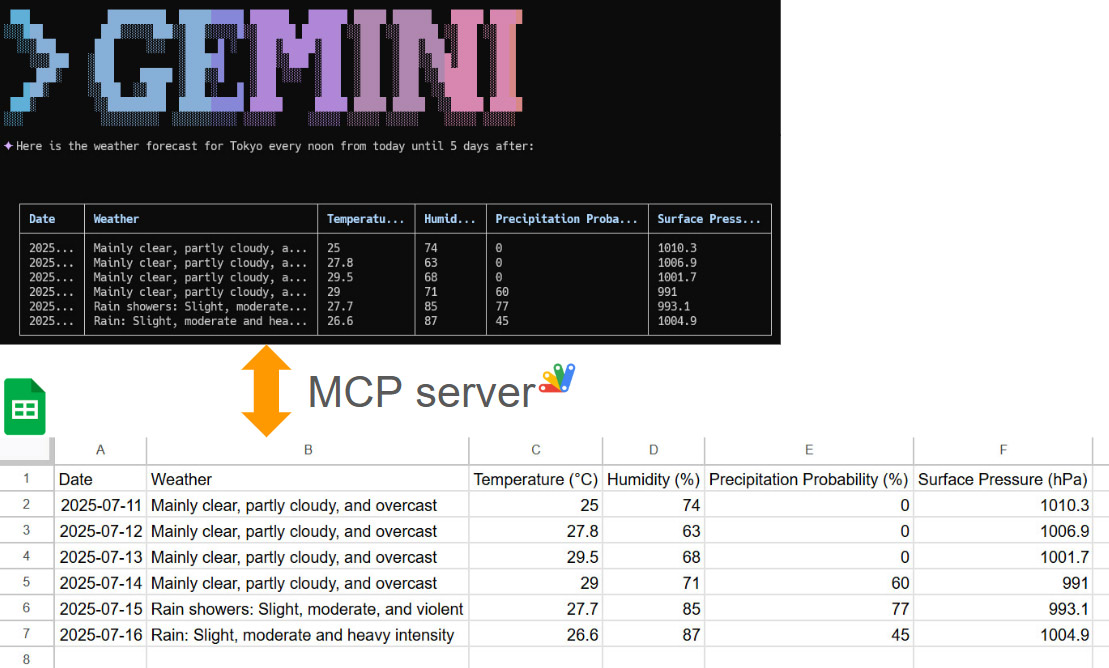
Managing Google Docs, Sheets, and Slides by Natural Language with Gemini CLI and MCP

Gists

Managing Google Docs, Sheets, and Slides by Natural Language with Gemini CLI and MCP

Abstract

This report explores an optimized approach to integrating the Gemini CLI with Google Workspace via an MCP server. Traditionally, this process requires numerous custom tools, which increases development costs. We propose leveraging the inherent JSON schema requirements of the MCP server tools to directly construct request bodies for the batchUpdate methods of the Google Docs, Sheets, and Slides APIs. This approach aims to consolidate document management into just three core tools, significantly streamlining development and offering a scalable, cost-effective solution for Google Workspace automation and broader API integrations.

Next-Level Data Automation: Gemini CLI, Google Sheets, and MCP

Gists

Next-Level Data Automation: Gemini CLI, Google Sheets, and MCP

Abstract

This article explores the integration of the Gemini Command-Line Interface (CLI) with Google Sheets using the Model Context Protocol (MCP). It demonstrates how to leverage the open-source projects MCPApp and ToolsForMCPServer to create a bridge between the Gemini CLI and Google Workspace. This enables users to perform powerful data automation tasks, such as creating, reading, and modifying tables in Google Sheets directly from the command line, using natural language prompts. The article provides practical examples and sample prompts to illustrate the seamless workflow and potential for building sophisticated, AI-powered applications within the Google Cloud ecosystem.

Gemini CLI: Featuring an Enhanced ToolsForMCPServer

Gists

Gemini CLI: Featuring an Enhanced ToolsForMCPServer

Abstract

This report introduces ToolsForMCPServer, an enhanced Google Apps Script library that expands the capabilities of Gemini CLI. It showcases new tools that streamline complex workflows, with a special emphasis on facilitating seamless file content transfer and management between a user’s local environment and Google Drive.

Introduction

This report details significant enhancements to ToolsForMCPServer, a powerful Google Apps Script library designed to work in tandem with Gemini CLI. By integrating this library with a Model Context Protocol (MCP) server, the capabilities of Gemini CLI are dramatically expanded, especially in its interaction with Google Workspace services. This document will explore the core architecture that makes this possible, introduce the new tools available in the library, and demonstrate their power through practical examples that bridge the local command line with the cloud.

Processing File Content Using Gemini CLI with an MCP Server Built by Google Apps Script

Gists

Processing File Content Using Gemini CLI with an MCP Server Built by Google Apps Script

Abstract

This report details two methods for processing files using the Gemini CLI and a Google Apps Script MCP server: direct Base64 encoding and indirect transfer via the Google Drive API using ggsrun. The direct method proved ineffective due to token limits. The recommended approach, leveraging ggsrun, allows for efficient, scalable file transfers by using file IDs instead of embedding content within the prompt, enabling advanced automation capabilities.