Abstract
Fields Builder for Google APIs is a client-side web application that streamlines constructing the fields parameter. It parses Discovery documents into interactive trees, enabling developers to visually select nested resources, implement Partial Response, and optimize API payload sizes without manual syntax errors.
Introduction
FieldsBuilderForGoogleAPIs is a specialized Web Application designed to streamline the construction of the fields parameter for Google APIs.
Since the update of the official Google API Explorer, developers have found it increasingly difficult to visually construct the fields parameter. This tool bridges that gap by parsing official Discovery documents to build an interactive, navigable tree view of the response schema.
The Importance of Partial Response
In the context of Google APIs, the standard response often includes a massive amount of metadata that may be irrelevant to a specific use case. By utilizing the fields parameter, developers can implement Partial Response. This practice offers critical technical advantages:
- Network Efficiency: Significantly reduces the payload size, lowering bandwidth consumption and latency.
- Parsing Performance: Reduces the CPU overhead required to parse large JSON objects on the client side.
- Complexity Management: Manually constructing field masks for deeply nested resources (e.g.,
items(id,snippet(title,thumbnails))) is error-prone. This tool automates the syntax generation, ensuring valid API requests.
Recent Updates and Architecture
Originally released on March 4, 2020, this tool has served as a utility for developers navigating complex API structures.
Recently, I conducted tests using Google Antigravity. Recognizing that FieldsBuilderForGoogleAPIs would serve as an excellent minimalist example of this technology in action, I have refactored and updated the application. This update not only enhances the tool but now effectively functions as a practical implementation sample for developers looking to integrate Google Antigravity into their own workflows.
Repository
https://github.com/tanaikech/FieldsBuilderForGoogleAPIs
Test this application
You can use this application from the following page.
https://sites.google.com/view/fields-builder
Features
- Support for ALL Google APIs: Dynamically loads the latest API discovery documents.
- Nested Resources: Fully supports APIs with deep resource hierarchies (e.g., Drive, Sheets).
- Optimized Fields Generation: Select a parent node to automatically include all its children in the fields string.
- Modern UI: Clean, dark-themed interface for better usability.
- Secure & Standalone: Runs entirely in the browser. No server-side code, no authorization, and no scopes required.
Usage
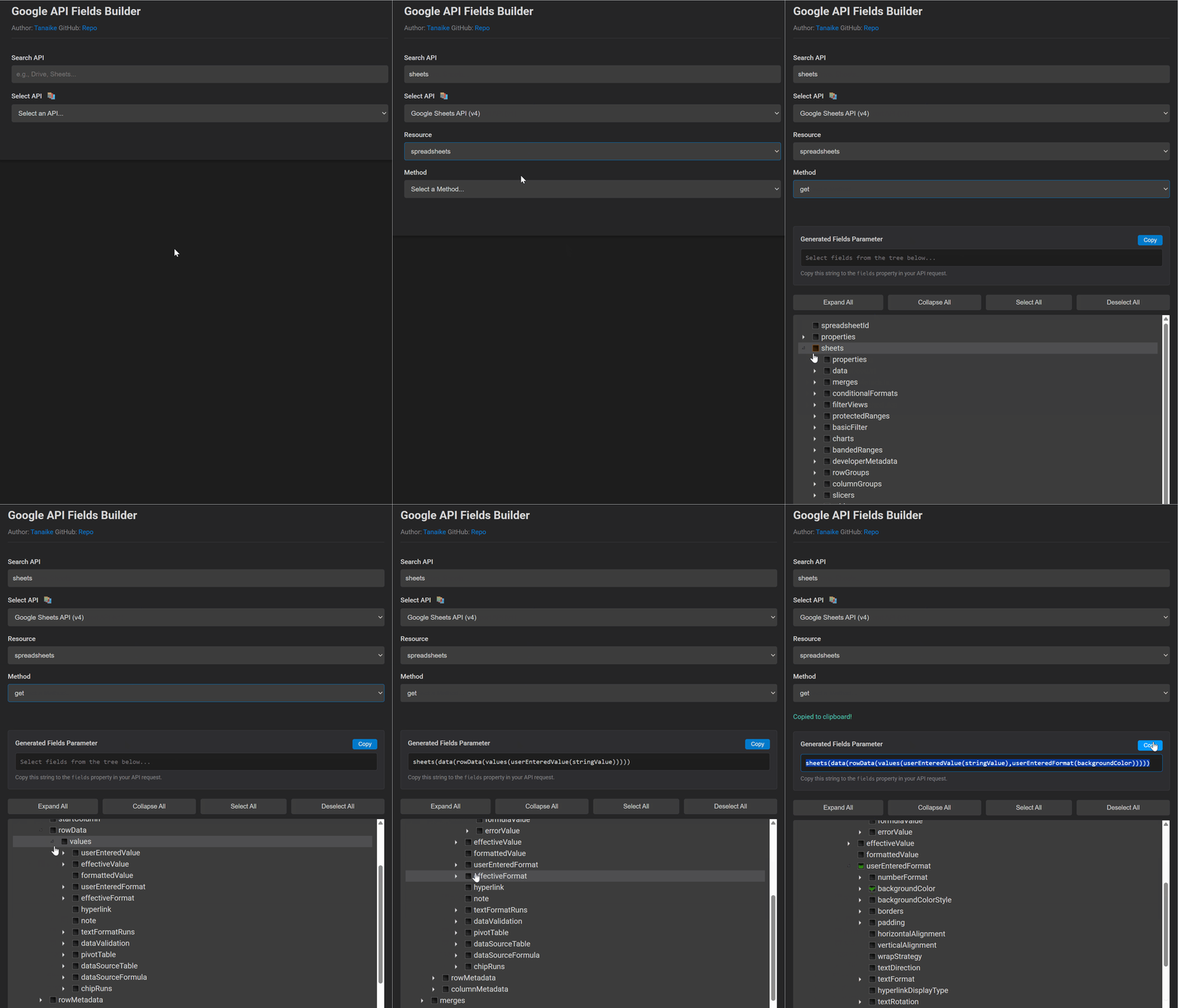
- Access https://sites.google.com/view/fields-builder using your web browser.
- Search/Select API: Type to search or select an API from the dropdown (e.g., “Google Drive API”).
- Select Resource: Choose the resource you want to access (e.g.,
files). - Select Method: Choose the method (e.g.,
list). - Select Fields:
- The response schema will be displayed as a tree.
- Check the boxes for the fields you want to retrieve.
- Selecting a parent node (e.g.,
userEnteredValue) will include it in the output, implying all its sub-fields.
- Copy: Click the “Copy” button to copy the generated string to your clipboard.
- Paste: Use the copied string as the value for the
fieldsparameter in your API request.
Summary
- Visual Schema Navigation: Replaces manual syntax construction with an interactive tree view for Google API response schemas.
- Partial Response Optimization: drastic reduction in payload size and latency by selecting only necessary data fields.
- Dynamic API Support: Automatically loads and parses the latest Discovery documents for all available Google APIs.
- Client-Side Security: Operates entirely within the browser without requiring user authorization or server-side processing.
- Tech Stack Implementation: Serves as a practical, open-source example of using Google Antigravity for web application development.